You have likely spent the last few quarters under pressure to “do more with less,” shaving every possible minute off your campaign launch process. There’s a specific exhaustion in squeezing a sponge that’s already dry, hunting for one more point of efficiency in a process that’s already lean. Streamlining matters, but running faster on the same treadmill doesn’t change the destination. The bigger return on investment comes from a different category entirely.
The tension we feel is the result of confusing “doing things right” with “doing the right things.” In MarTech and AI operations, we get so caught up in the plumbing that we forget why we built the house. To drive real value, look past simple optimization and understand the two distinct ways technology returns value to the enterprise.
The Two Pillars of MarTech ROI
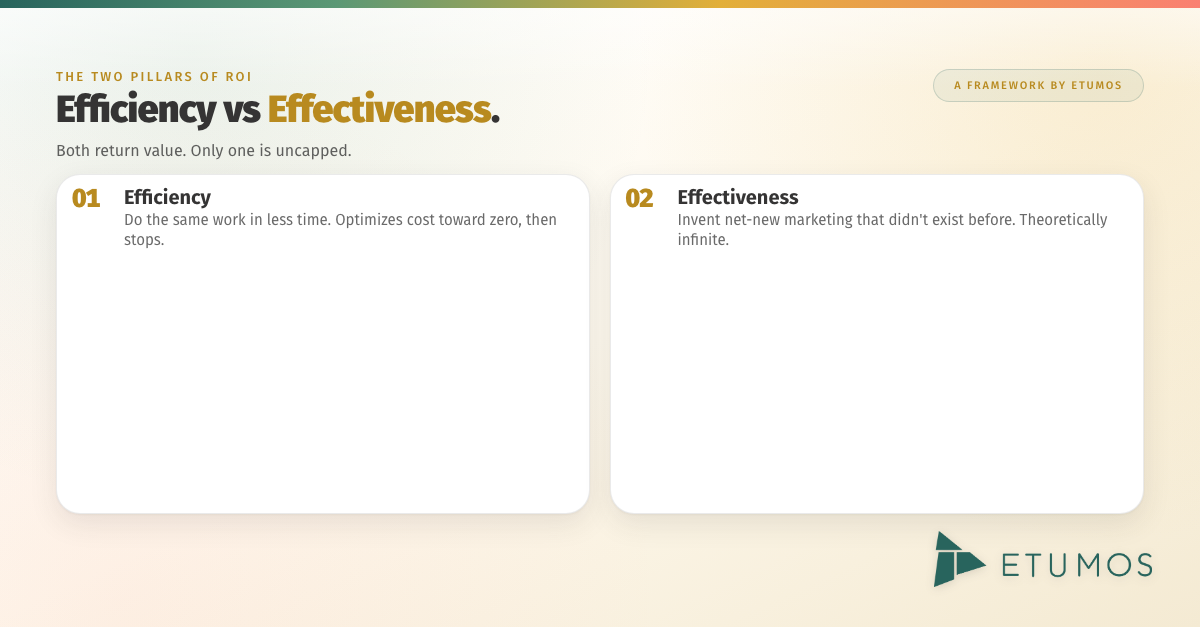
When you evaluate any technology, whether a new large language model (LLM) or a robust marketing automation platform (MAP), there are two return-on-investment categories to weigh: efficiency and effectiveness.
Imagine you manage a fleet of delivery trucks. Efficiency gains are about optimizing routes, reducing idle time, and getting the best gas mileage. You’re driving the cost of delivery toward zero. Effectiveness is about what’s inside the trucks. If you deliver the wrong products to the wrong customers, it doesn’t matter how fast or cheap the delivery was. Effectiveness is inventing a product customers actually want, or a new way to deliver value the competition hasn’t thought of.
MOps has historically been rewarded for efficiency: lead scoring models, automated handoffs, clean data flow. But as AI becomes standard, the efficiency bar is being lowered for everyone. The uncapped value, the ROI that earns a seat at the strategic table, lies in how you use that reclaimed time to increase effectiveness.
Efficiency: Doing the Same Work in Less Time
Efficiency is doing the same quality of work in the minimum time possible. In the AI era, if a human is still manually moving data from a spreadsheet into Marketo, or manually checking whether a lead routed in Salesforce, that’s a failure of efficiency.
The first move for any team is to optimize core processes to as close to zero human intervention as possible, using AI and orchestration layers to handle the boring work: data normalization, initial campaign staging, and basic QA. Audit your campaign lifecycle and find every point where a person simply moves data from A to B. Those are your primary targets.
Effectiveness: Inventing What You Couldn’t Before
Efficiency is the smaller slice of the total return. Focus only there and you’re playing a game of diminishing returns, because you can optimize a process down to zero but no lower. Effectiveness is theoretically infinite.
Using AI more intelligently lets you increase the effectiveness of individual campaigns. This isn’t making the current email 5% better; it’s new channels, new offers, and entirely new ways to market. Instead of a standard “Request a Demo” email, an effectiveness-focused team might use AI to build a custom, interactive ROI calculator personalized to a prospect’s industry and tech stack discovered through signal farming. That’s a net-new experience that converts far better than a generic offer.
To move toward effectiveness, build “effectiveness logic” into your data model, beyond simple if/then triggers toward multi-variable intent processing:
- The input: pull real-time signals from your data warehouse (for example, a prospect just searched for a competitor’s integration).
- The model: use an LLM to determine psychographic intent, not just what they did but why.
- The output: trigger a high-effectiveness response, like generating a custom comparison one-pager on the fly and alerting the account executive with a tailored talk track.
Instead of asking “how can we do this faster?”, ask “what is a marketing experience we literally couldn’t provide before AI?”
Why This Strategic Shift Matters
The technical ability to execute marketing is becoming commoditized. Every growth-stage B2B company now has powerful automation. Compete only on efficiency and you’re in a race to the bottom, where the prize is being the cheapest, most invisible brand in the inbox. High-performing RevOps teams use efficiency to buy back the time of their most creative people, then reinvest that time into the effectiveness of their go-to-market. That is how you move from “process manager” to “innovation architect.”
Frequently Asked Questions
What is the difference between efficiency and effectiveness in marketing operations?
Efficiency is doing the same work in less time and at lower cost, like optimizing delivery routes. Effectiveness is doing higher-impact work, like inventing a new marketing experience customers actually want. Efficiency is capped at zero cost; effectiveness is theoretically unlimited.
Where does AI deliver the highest ROI in MOps?
The biggest return comes from effectiveness, not efficiency. AI should first remove manual, low-value work, then free your team to design net-new campaigns and experiences that weren’t possible before, which drive far higher conversion than incremental optimization.
How do I measure effectiveness instead of just efficiency?
Move beyond metrics like “time to launch” and start tracking innovation velocity: the number of new campaign types, channels, or experiences your team ships each quarter. Pair it with conversion lift from those net-new plays.
What is an example of an AI-driven effectiveness play?
Instead of a generic demo email, use AI to generate an interactive ROI calculator personalized to a prospect’s industry and stack, or a custom comparison one-pager triggered by real-time intent signals. These create experiences that stand out from automated noise.
Decide Where the Car Should Go
The future of MOps isn’t just maintaining the engine; it’s deciding where the car should go. Optimize your workflows so the business doesn’t waste resources, but aggressively pursue the net-new inventions only modern technology makes possible. Etumos helps teams balance both, from agentic marketing operations to a roadmap for agentic revenue operations. If you want to shift from gas mileage to a better destination, let’s talk.