The best marketing ideas usually die in the same room: the one where someone says “we don’t have the dev resources for that.” You sketch a pricing calculator, a maturity assessment, or an interactive ROI tool that would genuinely help prospects, and the front-end queue is six months deep. Custom AI tools are what finally close that gap. With an AI agent doing the technical labor, the marketing operations professional stops being a requester of technology and becomes the builder of high-effectiveness assets, no engineering ticket required.
For years we settled for “good enough” because real custom development was too expensive: static PDFs, rigid landing-page templates, gated forms that ask for everything and give back nothing. That barrier is evaporating. Through a practice often called vibe coding, you can take a whiteboard sketch and ship it as a live, interactive microsite in a single afternoon.
What Are Custom AI Tools (and What Is Vibe Coding)?
Custom AI tools are purpose-built marketing assets (calculators, assessments, diagnostics, microsites) that you create by directing an AI agent in plain language instead of writing code by hand. The method behind them is vibe coding: a way of building software where you describe the behavior, the business logic, and the user experience, and the AI writes, tests, and deploys the functional code. It abstracts away the deep syntax of JavaScript, Python, or CSS so you can focus on the outcome.
Think of the difference between a master carpenter and an architect working in 3D modeling software. The carpenter (the traditional developer) has to know how to cut every joint and drive every nail. The architect (you, the builder of custom AI tools) focuses on the flow of the room, where the windows go, and the utility of the space. The AI is the construction crew that takes those high-level designs and builds the structure instantly. You shift from a 1x productivity model to an effectiveness model where the only ceiling is the quality of your ideas, not the size of your engineering budget.
From Static Whitepapers to Interactive Calculators
The “download this PDF” era is saturated. Prospects want answers, not homework. Custom AI tools let you build a pricing calculator or an ROI diagnostic that lives as a standalone microsite, solving a specific problem for the user while collecting rich, first-party data for your RevOps team.
Say you want a “Marketing Operations Maturity Assessment.” Instead of a 10-question static form, you build a multi-step interactive app: it asks about the user’s tech stack, scores the answers in the background, and generates a custom report on screen. Because you built it with an AI agent yourself, you can make it map perfectly to the custom fields in your Salesforce or HubSpot instance.
A practical first move: ask your sales team for the single question they answer most often, usually some version of “how much will I save?”, and build a simple interactive calculator that answers it. One tool like that delivers more value than a dozen blog posts.
Intelligent Lead Gating and Contextual Logic
Custom AI tools also let you escape the binary “gated vs. ungated” debate. You can build logic that offers value first and gates later, or soft-gates content based on what the user actually enters. The pattern that makes this work is the webhook-enabled microsite, and it has three parts:
- The interface: a front end that captures user inputs, like number of leads or average deal size.
- The logic: a function that calculates a custom result (an ROI figure, a maturity level) based on your proprietary business math.
- The handoff: a webhook that sends a clean JSON payload, with the email, the raw inputs, the calculated ROI, and the score, straight into your marketing automation platform.
Because the AI builds the whole flow, the data landing in Marketo or HubSpot arrives pre-processed and ready for a hyper-personalized sales follow-up, not as a raw form dump someone has to clean up later.
Why This Matters for 2026
The companies that win in 2026 will be the ones offering the least friction and the most value during the self-education phase of the buyer’s journey, the part that happens in dark social, before anyone fills out a “contact sales” form. Traditional marketing operations managed the pipes that carried the content. The shift now is toward building the experiences themselves.
Custom AI tools are the ultimate multiplier for effectiveness: they let a small MOps team operate like a full-service digital agency. The old tech stack is commoditized (everyone has a CRM and an email tool), so the competitive moat is now the custom, interactive artifacts your competitors are not technically agile enough to produce. You are no longer just scaling content. You are scaling intelligence and utility.
Your Roadmap to Custom Tooling
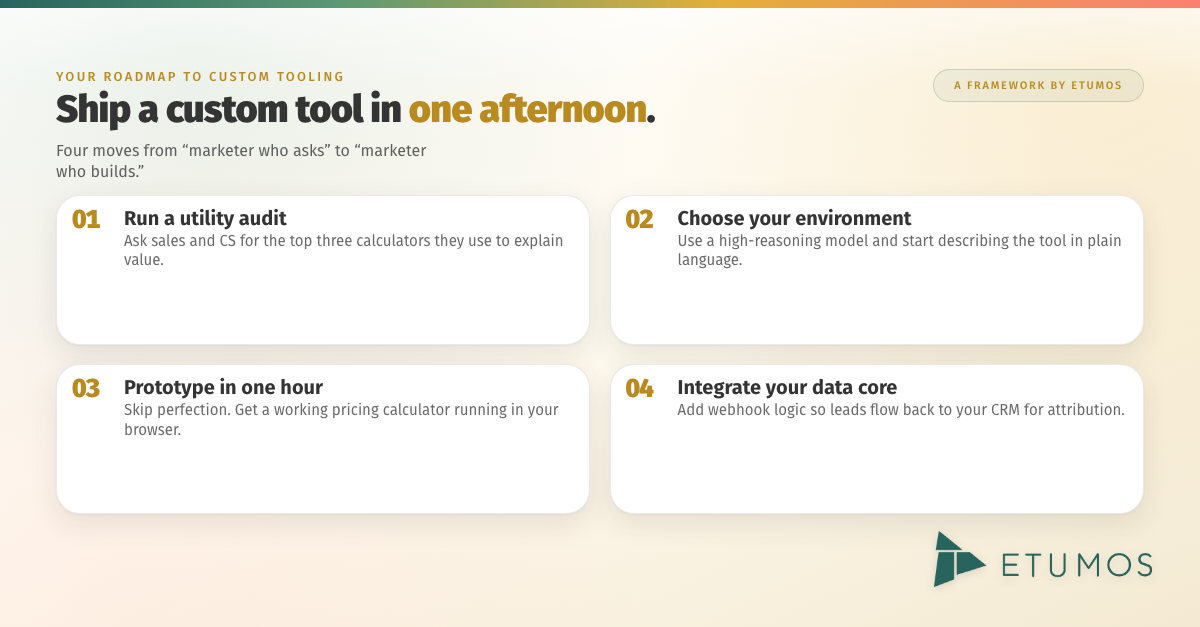
The move from “marketer who asks for things” to “marketer who builds things” starts with one project and a shift in mindset. You don’t need a computer science degree, just a clear vision and the right AI coworker.
- Run a utility audit: ask sales and customer success for the top three spreadsheets or calculators they use internally to explain value to customers.
- Choose your environment: use a high-reasoning model (Claude with Artifacts enabled, or a dedicated coding assistant) and start describing your tool.
- Build a prototype in one hour: don’t aim for perfection. Describe a simple pricing calculator and get a functional version running in your browser.
- Integrate with your data core: once it works, add the webhook logic so the data flows back to your CRM for proper attribution and follow-up.
The future of marketing operations is written in natural language. Building custom AI tools today turns your department from a cost center into a high-effectiveness innovation lab.
Frequently Asked Questions
What are custom AI tools in marketing operations?
Custom AI tools are purpose-built marketing assets like pricing calculators, maturity assessments, ROI diagnostics, and interactive microsites that you create by directing an AI agent in plain language. Instead of waiting on a dev queue, you describe the behavior and logic and the AI writes, tests, and deploys the code, so a small MOps team can ship experiences that used to require an engineering project.
Do I need to know how to code to build custom AI tools?
No. The practice, often called vibe coding, abstracts away the syntax of JavaScript, Python, and CSS. You focus on the business logic, the user experience, and the desired outcome, and the AI agent generates the technical artifacts. The skill that matters is a clear vision for the tool, not deep programming knowledge.
How do custom AI tools connect back to my CRM or marketing automation platform?
Through a webhook-enabled microsite. The tool captures user inputs on the front end, runs your business logic to calculate a result, then fires a webhook that sends a clean JSON payload (email, raw inputs, calculated ROI, and score) into Marketo, HubSpot, or Salesforce. The data arrives pre-processed and ready for personalized follow-up.
What is a good first custom AI tool to build?
Start with the question your sales team answers most often, usually “how much will I save?” Build a simple interactive ROI or pricing calculator that answers it, get a functional prototype running in about an hour, then add the webhook logic so leads flow back to your CRM. One high-utility tool like this outperforms a dozen static blog posts.
Build the Tool Your Strategy Has Always Demanded
The bottleneck was never your ideas; it was the labor required to ship them. Custom AI tools remove that constraint, so the only question left is which interactive experience you build first. Etumos helps teams operationalize this shift, from agentic marketing operations to agentic operations and a roadmap for agentic revenue operations. If you have a tool you’ve always wanted to build but were told was too expensive, let’s talk.