You have likely spent the last few months bombarded with “hacks” on how to let AI write your entire content calendar or manage your lead routing on autopilot. The reality is that as everyone hits the “easy button,” the market is filling with lukewarm, generic noise that buyers find easy to ignore. If your automated outreach feels like it’s losing its soul, you are not alone. The fix is a clear hierarchy: human strategy drives, and AI executes.
The risk in marketing operations (MOps) isn’t that AI replaces us. It’s that we abdicate our strategic responsibility and let the tools drive the car. When we stop being the architects and become observers of our own tech stack, our value to the organization plummets.
The “Driver and Engine” Paradigm
To reach true operational maturity, adopt a specific hierarchy: human strategy is the driver, and AI is the execution layer. The human brain provides the “why,” the “who,” and the “how it feels.” The AI provides the “at scale” and “at speed.”
Think of a high-performance Formula 1 car. The AI is the engine, capable of output a human could never match physically: millions of data points processed, thousands of micro-adjustments per second. But the engine has no concept of a finish line, no race strategy, and no ability to navigate a sudden rainstorm. The human in the cockpit is the driver, making the split-second strategic calls and pointing that massive engine at a specific goal. In MOps, you provide the customer insight, the brand nuance, and the campaign logic, then use LLMs and the Model Context Protocol (MCP) to turn that strategic spark into a high-speed execution fire.
Elevating Human Strategy Above the Noise
AI does not replace human thinking; it magnifies it. Feed a generic, low-intelligence strategy into a powerful AI and you get generic noise at extreme scale. Apply a sophisticated strategy, and the AI becomes a force multiplier.
Scaling the “unscalable” with agentic workflows
The best use of AI today is taking a complex, manual task that was previously unscalable and letting an agentic workflow handle the repetition. Imagine a personalized “ABM-lite” play for 500 target accounts. Researching each company’s recent filings, identifying their top three priorities, and mapping them to your product would take a human researcher weeks. In a human-driven, AI-executed model, the MOps professional defines the strategy (“find mentions of digital transformation in the CEO’s letter and draft a note connecting it to our efficiency gains”), and the AI reads the documents, finds the quotes, and stages the personalized emails in Marketo or HubSpot.
Building technical guardrails for human logic
To keep the AI on the track you designed, you need an orchestration layer that prioritizes your data over the model’s background training. When you build an AI-enabled workflow in a tool like Workato or n8n, don’t just send a lead’s email to an LLM. Build a “strategy injection point”:
- Context retrieval: pull the brand style guide and current campaign strategy from your internal database.
- Constraint definition: instruct the AI to execute the task using only the provided guidelines, not background training data.
- The work: the AI executes (for example, summarizing a lead’s pain points).
- The audit: a final logic gate checks the output against your human-defined data so no hallucinations slip through.
Standing out through “primary source” intelligence
AI is trained on the past; human strategy is focused on the future. Because LLMs are predictive models, they are groupthink machines that suggest the most statistically average path. To stand out, inject primary-source intelligence: your proprietary data, your customer interview transcripts, your specific differentiators. When your own brain is the primary source, the AI’s output becomes a unique asset instead of a recycled commodity.
Why the Human-AI Hybrid Matters
The novelty of AI-generated content has vanished. Buyers are developing “AI filters” the way they developed ad-blindness in the early 2000s. The only campaigns that break through feel authentically informed and strategically sharp. Operational maturity is no longer defined by how much AI you use, but by your driver-to-execution ratio. The strongest growth-stage teams are small and elite, spending roughly 80% of their time on human strategy and 20% managing the agents that do the heavy lifting. That ratio delivers extraordinary output without the quality collapse that usually follows mass automation.
Becoming the Strategic Architect
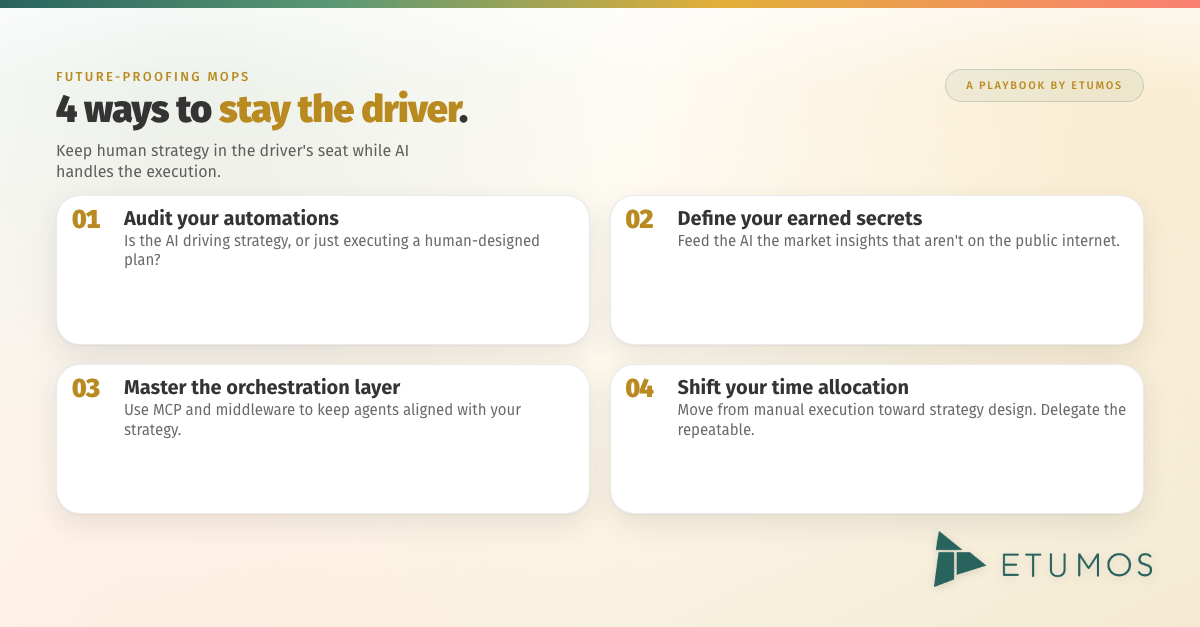
We are moving from “tool managers” to “strategic architects.” The future belongs to those who master the technical complexity of AI execution while never losing sight of the human strategy that makes it worth doing. Four steps to start:
- Audit your automations: is the AI driving strategy, or simply executing a human-designed plan?
- Define your “earned secrets”: the unique market insights your company holds that aren’t on the public internet. Put them in your AI context windows.
- Master the orchestration layer: use MCP and middleware to build guardrails that keep agents aligned with your strategy.
- Shift your time allocation: move away from manual execution toward strategy design. If a task is repeatable, it’s an execution task, so delegate it to the engine.
Frequently Asked Questions
What does “human as the driver, AI as the engine” mean?
It’s a hierarchy for marketing operations where human strategy sets direction (the why, who, and how it feels) and AI provides scale and speed of execution. The human makes the strategic decisions; the AI carries them out at a volume a person never could.
Will AI replace marketing operations roles?
No. The real risk is abdicating strategy to the tools. AI magnifies human thinking rather than replacing it, so the professionals who define strategy and govern the agents become more valuable, not less.
How do I stop AI from producing generic content?
Feed it primary-source intelligence: proprietary data, customer interview transcripts, and your specific differentiators. Generic input produces average output, while unique input turns AI into a distinctive asset.
What is a “strategy injection point”?
It’s a multi-step workflow that retrieves your brand and strategy context, constrains the AI to use only that context, runs the task, and audits the output against your data. It keeps agents aligned with your strategy and guards against hallucinations.
Make Yourself the Driver
Position yourself as the driver and AI as the engine, and you build a marketing machine that is as intelligent as it is fast. Etumos helps MOps teams build that orchestration layer, from agentic marketing operations to governed AI workflows on your existing agentic operations stack. If a project on your roadmap is leaning too hard on “AI default” thinking, let’s talk.