
You have likely spent the last few quarters under pressure to deploy AI agents for lead scoring, personalized outreach, and “next best action” recommendations. Then you look at your actual database: the missing job titles, the duplicate accounts, the “trash” lead records that have piled up for years. Point a high-speed AI engine at a messy data set and you do not get innovation. You get your mistakes, automated. The real bottleneck for AI adoption is not the model. It is the data tech debt you have carried since the early days of your CRM and marketing automation platform.
If you do not have a factual, reliable, maintained data core, your AI initiatives will produce hallucinations and foot-in-mouth marketing at scale. To pursue AI excellence, you have to treat data operations as the non-negotiable foundation of the entire house.
What Data Tech Debt Means in the AI Era
In marketing operations, data tech debt is the accumulated cost of unmaintained, incomplete, or inaccurate records inside your revenue systems. It is the technical equivalent of interest on a high-rate credit card. Every day you leave a field unstandardized or an account unlinked, the cost of using that data for a real decision goes up.
Think of your data core as fuel for a high-performance jet engine. If the fuel is contaminated with dirt and water (messy data), the engine might still start, but it will sputter, stall, or fail mid-flight. In a pre-AI world, bad fuel meant your attribution was slightly off or your SDRs dialed a few dead phone numbers. In a 2026 AI-first world, the same debt is far more dangerous. When an AI agent builds a profile or drafts a one-to-one message from garbage data, it does so with total confidence. You lose the ability to tell a brilliant insight apart from a hallucination born of a corrupt field. Everything beyond the data core is an abstraction, and if the core is untrustworthy, the whole system is a liability.
The Real Risk: Slop at Scale
The first cost of ignored data tech debt is what we call AI slop. Feed an agentic system a database full of unverified titles and mismatched industry codes and the output is generic, low-quality, and often flat wrong. Ask an LLM to generate personalized event invites when your “Industry” field is 40% blank and 20% “Other,” and the model will guess from its background training instead of your primary facts.
Guarding against slop means prioritizing the cleanliness of revenue and customer data across every layer of the stack: leads, contacts, accounts, and opportunities. The shift that matters is from reactive cleaning to proactive maintenance, so the agents you deploy always work from the highest possible level of marketing intelligence.
Using Agents to Pay Down the Debt
Here is the turn that makes this tractable: while data tech debt is the problem, AI agents can be the solution. We all know the historical gap. Salespeople hate data entry, and any enrichment or intelligence field that is not automated is almost certainly being ignored.
Instead of waiting for a human to clean the database, you can stand up specialized agents built for data operations. These agents do the drudge work of enrichment (researching profiles, validating company headquarters, normalizing job functions) at a speed and scale humans cannot match. A practical example: deploy an agentic worker that fires every time a new lead enters HubSpot or Marketo with a missing job level. The agent reviews the prospect’s recent activity, infers seniority, and updates the field in real time. By the time your targeting agent picks up that lead, the debt on that record is already settled.
How It Works: The Data Cleansing Webhook
To operationalize this, you need a technical bridge between your messy CRM data and your cleaning agents. The reliable pattern is an asynchronous webhook flow that enforces data integrity before a lead is ever marked “Sales-Ready.”
- Trigger: a lead is created or updated but fails a data-health validation rule (for example, missing firmographic data).
- Webhook: your platform sends a JSON payload with the partial data to an orchestration layer such as Workato or n8n.
- Agentic action: an agent uses a search tool or enrichment API to fill the gaps.
- Validation logic: before anything is written back, a second LLM-based audit agent checks the new values against your internal source-of-truth rules for formatting and accuracy.
- Write-back: the clean data lands in the CRM and a “Data Verified” flag is set to true.
Without this layer, your AI is a fast car driving in the dark with no headlights. Factual data is the vision. When an agent can cross-reference its own logic against primary facts, you stop hoping the AI is right and start giving it the infrastructure to be right. That is how you prevent hallucinations.
Why a Clean Data Core Wins in 2026
As the market moves toward agentic everything, competitive advantage shifts away from who owns the best model and toward who owns the best data core. In 2026, every growth-stage company has access to powerful LLMs. Very few have a database clean enough to use them well.
Operational maturity now demands a “data first, AI second” philosophy. Try to leapfrog the hard work of data operations to reach the fun part of AI and you end up with a fragmented, unreliable stack that creates more problems than it solves. The teams that settle their data debt now are the ones that scale marketing and sales intelligence with confidence, while their competitors spend the year apologizing for AI-generated mistakes.
Your Path to a Trustworthy Data Core
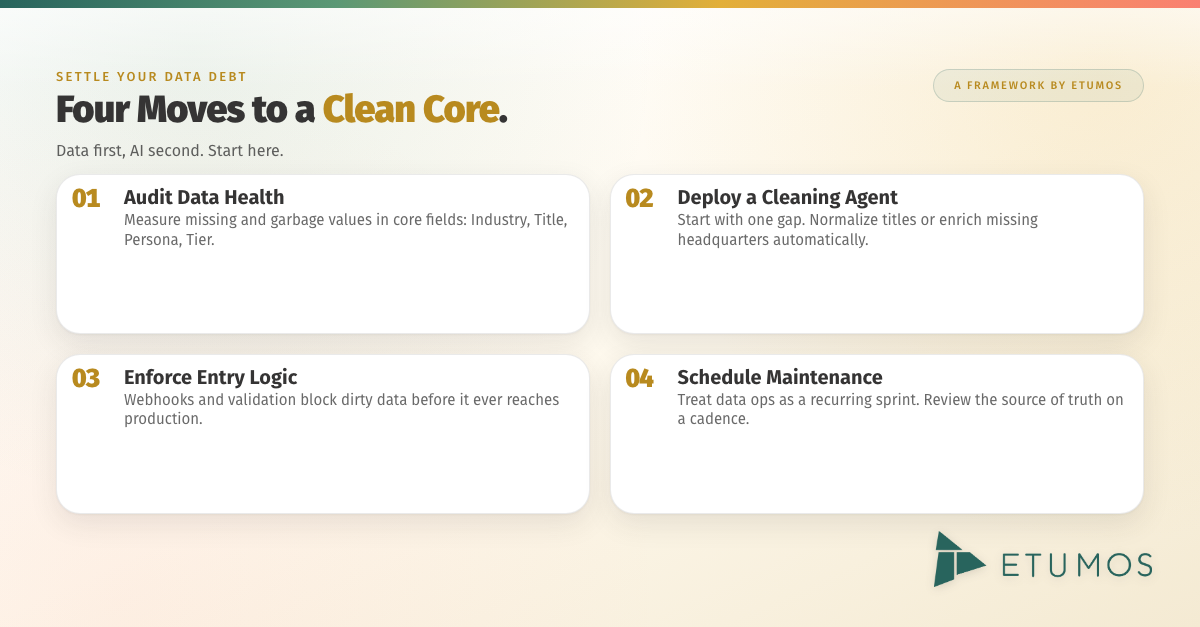
Addressing data tech debt is not a one-time project. It is a fundamental shift in how you run revenue operations. Start with four concrete moves:
- Audit your data health. Run a report on your core fields (Industry, Job Title, Persona, Account Tier) and measure the percentage of missing or garbage values in the system today.
- Deploy one cleaning agent. Start small with a workflow that solves a single gap, such as normalizing job titles or enriching missing headquarters locations.
- Enforce strict entry logic. Use webhooks and automated validation so no dirty data reaches production without being scrutinized.
- Set a maintenance schedule. Treat data operations as a recurring sprint, and review the source of truth for your most critical account and lead fields on a cadence.
The future of marketing operations belongs to teams that prioritize the core over the abstraction. Etumos helps you get there, from agentic marketing operations to agentic operations and a roadmap for agentic revenue operations.
Frequently Asked Questions
What is data tech debt in marketing operations?
Data tech debt is the accumulated cost of unmaintained, incomplete, or inaccurate records in your revenue systems: missing job titles, duplicate accounts, blank firmographic fields. Like interest on a credit card, the cost of relying on that data for decisions compounds every day it goes unaddressed, and it becomes far more dangerous once AI agents start acting on it with confidence.
Why does data tech debt break AI initiatives?
AI agents act on the data they are given without doubting it. Feed an agent unverified titles and mismatched industry codes and it generates confident but wrong output, what we call slop at scale. Without a factual, maintained data core, you cannot tell a genuine insight apart from a hallucination, so the whole AI system becomes a liability rather than an advantage.
Can AI agents help fix data tech debt?
Yes. The same agents that consume your data can also clean it. Specialized data-operations agents handle enrichment drudge work (researching profiles, validating headquarters, normalizing job functions) at machine speed. A common pattern fires an agent whenever a lead enters HubSpot or Marketo with a missing field, enriches it, and settles the debt on that record before any targeting agent ever sees it.
Where should a team start with data tech debt?
Start with an audit of your core fields to quantify how much missing or garbage data you actually have. Then deploy one cleaning agent against a single gap, enforce strict entry logic with webhooks and validation so dirty data cannot reach production, and put data operations on a recurring maintenance schedule. Small, durable wins beat one heroic cleanup that decays.