
Upleveling marketing ops no longer means clicking buttons faster. It means deciding what the machine does next. If you have spent enough Friday afternoons cleaning a lead list by hand or triple-checking that a smart-list filter won’t email your entire database, you already feel the ceiling. The manual productivity ceiling has been reached. The work ahead is not about typing every character of a workflow. It is about architecting the flow of data and managing the agents that execute it.
That shift is the heart of the agentic era in marketing operations. Your value is moving away from your ability to configure a tool and toward your ability to direct the AI that configures it for you. Below is how the shift actually works, where to start, and why the window to adapt is closing faster than most teams expect.
What “Upleveling Marketing Ops” Actually Means
For years, marketing ops has been defined by fluency in the backend of complex systems: moving field by field through Marketo, Salesforce, HubSpot, and Eloqua. Every time a legacy vendor announces a new “AI feature,” you feel the same tension. Will this save real time, or is it one more UI element to babysit?
The real transformation is not happening inside those platforms. It is happening in a layer that sits on top of them. There is a clear divide now between “old technology,” the platforms built before the 2023 generative-AI explosion, and the agentic layer that orchestrates them. Old technology still runs the campaigns. The agentic layer increasingly decides how.
The MCP: A Chatbot With Teeth
To understand the shift, you need to understand the MCP, or Model Context Protocol. The simplest way to describe an MCP is a chatbot with teeth. A standard AI writes you an email draft. An agent enabled through an MCP can actually take action. It reads your standard operating procedures, then uses API keys to click the buttons, move the data, and configure the settings inside your SaaS tools.
Think of it like the difference between a GPS and a self-driving car. A standard AI tells you where to go. Agentic AI drives the vehicle to the destination. In campaign operations, that means the AI does not just suggest a list cleanup. It identifies the bad data, runs the cleaning script, and ports the finished list into your production environment while you stay focused on strategy.
Three Places Upleveling Marketing Ops Starts
1. The End of Manual List Management
List management has always been the drudge work of campaign operations: deduplication, formatting, manual uploads. With an agentic layer, that entire process gets upleveled. Instead of a human walking through a ten-step SOP for list cleaning, you hand the task to an agent.
Picture a messy CSV from a third-party event. Instead of opening Excel, you task your agentic worker: “Clean this list against our standard formatting rules, dedupe against our Marketo instance, and upload to the Q3 Webinar program.” The agent executes the API calls, handles the logic, and reports back when the task is done.
The takeaway is to audit your current campaign SOPs and find the low-logic, high-repetition tasks like list uploads and field normalization. Those are the primary candidates for your first agentic deployments.
2. Managing the Tools That Manage the Tools
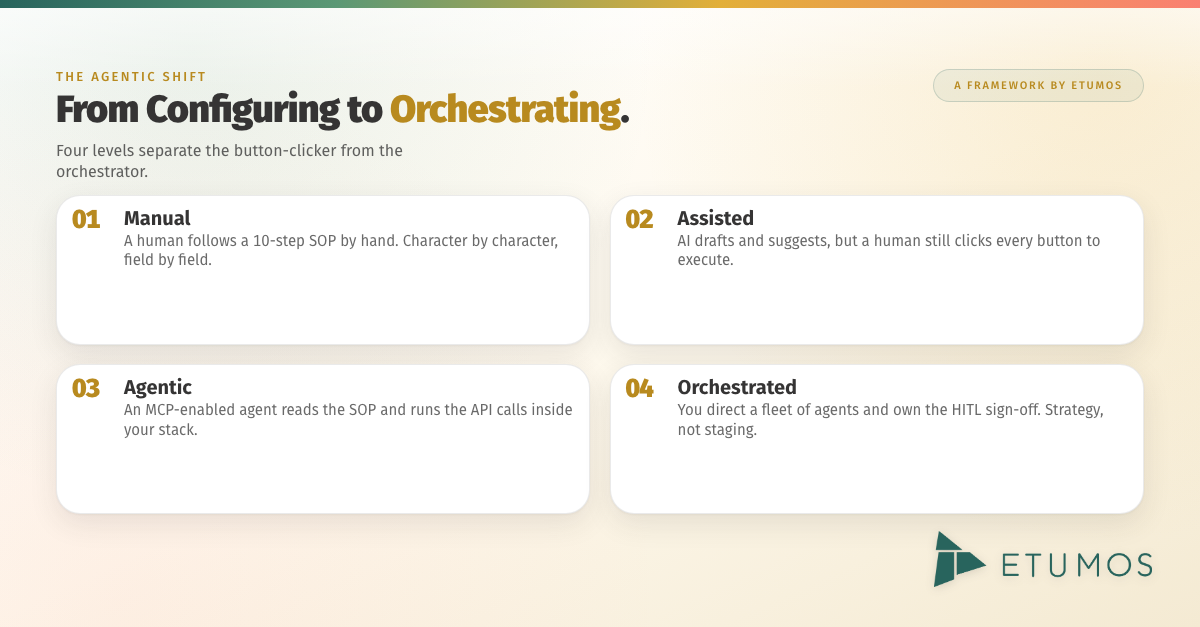
Marketing ops professionals are no longer just administrators. They are becoming orchestrators. The same way developers upleveled from typing every line of code to directing AI through configurations, marketers are doing it for the MarTech stack. The new job is to keep the agentic AI consistent with brand standards so it never becomes a liability.
To make this work inside old technology like Marketo or Salesforce, teams use a trigger-based webhook loop:
- The prompt: a human strategist sets an abstract goal, for example “build a three-touch nurture for the security persona.”
- The agentic logic: the agent queries your data core (Snowflake or BigQuery) to learn the persona’s historical behavior.
- The configuration: through an MCP, the agent sends API calls to your marketing automation platform to clone templates, update tokens, and set the flow logic.
- The human in the loop: before anything goes live, the agent summarizes its actions for your final QA sign-off.
3. Turning SOPs Into Repeatable Agentic Modules
The key to future-proofing your department is documentation. For an agent to be effective, it needs highly consistent, repeatable instructions. We are shifting from training humans to prompting systems. When your SOPs are documented with technical precision, they become the source code the agentic layer runs on.
In a tool like Workato or n8n, you can build a lead-enrichment agent that monitors every new lead in Salesforce. If a lead is missing a job title, the agent scrapes the public profile, finds the title, and updates the record. By the time a salesperson opens the lead, the manual labor is already done.
Why This Matters for 2026
The early-adopter phase of AI is ending. If you have not begun integrating agentic layers into your operations, you are already behind. This is not a nice-to-have efficiency gain. It is a fundamental change in how teams work.
We are entering an era of hybrid workforces, where the best human minds are the source of strategy and agentic AI is the multiplier on execution. That is what lets growth-stage companies hit enterprise output without enterprise headcount. Within the next few months, managing these chatbots with teeth will be the defining skill of a senior marketing operations professional. The gap between a 1x team and a 1,000x team is no longer talent. It is whether you direct the machine or get replaced by it. This is the practical core of agentic marketing operations, and it is why mapping it to a full agentic revenue operations roadmap matters now rather than next year.
How to Start Upleveling Marketing Ops This Quarter
Moving to agentic-first operations is a shift in how you spend your time. You move from the person who does to the person who directs. Four steps get you there:
- Identify your MCP targets. Look at your SaaS stack and find the tools with the most robust APIs. Those are the easiest places to deploy an agentic layer first.
- Codify your SOPs. Take one manual process, like campaign staging, and write it down with enough precision that a machine could follow it. That is your prompt-engineering foundation.
- Establish HITL governance. Decide now where a human must intervene for quality assurance before an agent publishes to production.
- Start small and specialized. Do not automate everything. Deploy one agent for one task, like list cleaning, and prove reliability before you scale.
The future of marketing operations is extraordinary scale with an uncompromising bar for excellence. Master the agentic layer today and you stay the one driving the machine. If you want a partner to design that agentic operations foundation with you, let’s talk.
Frequently Asked Questions
What does upleveling marketing ops mean?
Upleveling marketing ops means shifting your value from configuring tools by hand to directing the agentic AI that configures them for you. Instead of following a ten-step SOP to clean a list or stage a campaign, you set the goal, govern the human-in-the-loop checkpoints, and let agents execute the repetitive API work.
What is an MCP in marketing operations?
An MCP, or Model Context Protocol, is the layer that turns a chatbot into an agent that can take action. Rather than only drafting an email, an MCP-enabled agent reads your SOPs and uses API keys to move data, clone templates, and configure settings directly inside tools like Marketo and Salesforce. The shorthand is a chatbot with teeth.
Which tasks should I hand to an agent first?
Start with low-logic, high-repetition work: list deduplication, field normalization, list uploads, and lead enrichment. These tasks have clear rules and obvious success criteria, which makes them reliable first deployments. Prove the agent works on one narrow task before expanding to campaign staging or nurture builds.
Will agentic AI replace marketing ops professionals?
No, but it will redefine the role. The professionals who thrive will move from doing the manual work to directing fleets of agents and owning the quality-assurance sign-off. The risk is not the technology itself. It is staying at a 1x manual productivity level while the rest of the industry orchestrates execution at scale.