
The conversation about AI and Marketo has finally moved past writing email subject lines. For years the routine was the same: a campaign request lands, and you start cloning programs, renaming assets, updating tokens, and hand-checking smart campaign logic. We accepted that manual burden as the cost of doing business in marketing operations. That era is ending. AI is no longer just talking to us about Marketo. It is starting to talk directly to Marketo, and that changes the job.
The shift is from manual web app management to orchestrated, agentic execution. You give a high-level command and let an agent drive the platform. Understanding the protocol that makes this possible is the difference between watching the change happen and steering it.
What Is the Model Context Protocol (MCP)?
The term you are about to hear everywhere, especially with Adobe Summit on the horizon, is the Model Context Protocol (MCP). Think of MCP as a universal translator and a high-speed highway between a large language model (LLM) and a complex system like Marketo.
In the old way of working, getting an AI to help you build something in Marketo meant copying and pasting context back and forth by hand. MCP removes that. It gives the model a standardized way to “understand” the internals of the platform: the folders, the programs, the smart campaign logic. It also gives the model a protocol to take action on what it sees.
Picture a world where you do not log into the Marketo web app to build a webinar program. Instead you interact with an agentic AI that uses MCP to see your existing templates and drive the system to create, rename, and organize assets for you. It is the difference between a pilot flipping every switch in the cockpit and a pilot giving a high-level command to a flight computer. MCP is the infrastructure that makes the flight computer possible for marketing operations.
How AI and Marketo Change the Game
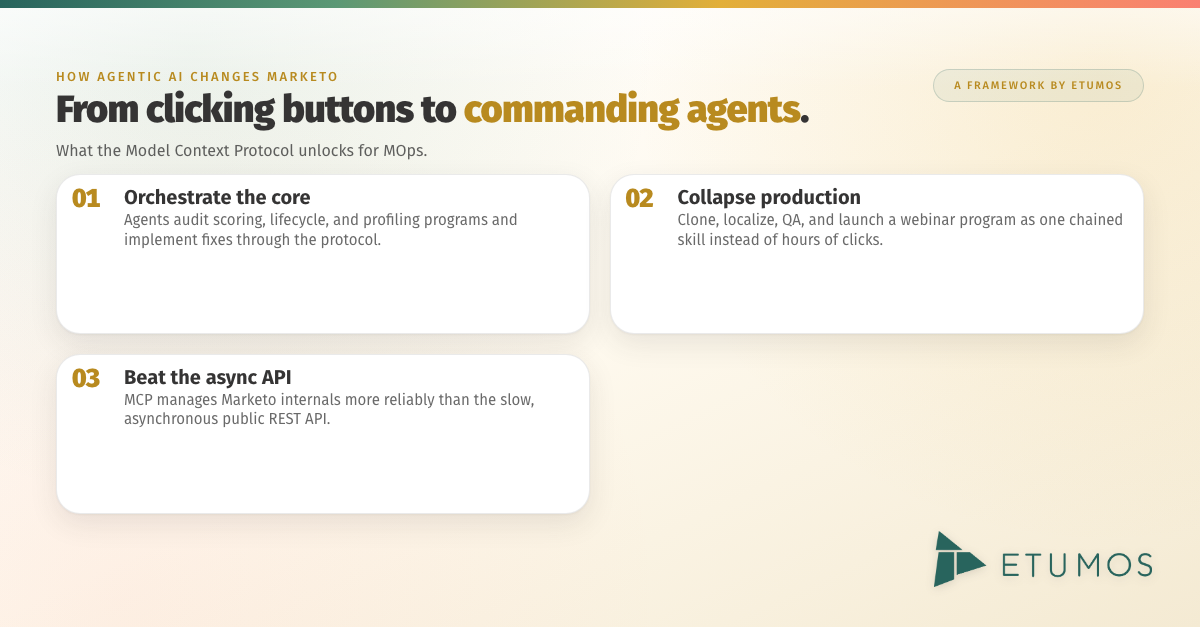
When you connect agentic AI to Marketo through a protocol like MCP, three parts of the job change at once.
1. Orchestrating the operational core
Marketo’s deepest value lives in its operational programs: the work engine that handles lead lifecycle, scoring, profiling, and alerts. These programs are powerful and fragile. A single error in a scoring trigger can ripple through your entire database.
With an MCP-driven approach, you move from manual configuration to orchestrated management. An agent can analyze your existing scoring logic and, through the protocol, suggest and implement optimizations to your profiling programs. Instead of spending days auditing a lifecycle model, you let an agent run the audit and report on individual lead records in real time.
2. Collapsing the campaign production layer
Campaign programs, the webinars and emails and event programs you build daily, are a massive share of the MOps workload. The current workflow carries heavy front-end costs: email QA, landing page QA, and flow setup. When you manage Marketo through MCP, those manual steps become chained skills. A single trigger can command an agent to:
- Clone a webinar template from a standardized source program.
- Localize the smart campaign naming conventions based on a regional folder structure.
- Run a QA check on the flow steps to confirm no “wait” steps are missing.
- Alert the campaign manager once the program is “Launch Ready.”
3. Overcoming API asynchronicity
If you have ever built your own DIY connection to Marketo, you have hit the limits of the REST API. It is notoriously slow and, more importantly, asynchronous. When you send a command to make a program, the system does not always return an immediate “done.” It starts a process. Try to rename a folder before that first process finishes and the call fails.
That is why a DIY approach needs a real orchestration layer: one that sends the request, checks status, and only runs the next step once the previous one is confirmed. Adobe’s internal rollout of MCP promises to manage these internals more effectively, offering a more reliable and faster path than the public REST API allows today.
From System Admin to Agent Architect
As we move through the 2026 landscape, the role of the MOps professional is evolving from “system admin” to “agent architect.” Agentic features inside Adobe Marketo Engage mean you are no longer just managing a database. You are managing a fleet of worker agents.
This is a full-frontal impact on the profession. Operational maturity will no longer be measured by how well you know the Marketo UI. It will be measured by how effectively you can chain AI skills and conversation-level actions together. The goal is to remove repetitive work so your team can run thousands of personalized programs that would be impossible to maintain by hand. This is where Etumos lives, building the strategy behind agentic marketing operations rather than babysitting the buttons.
Getting Ready for the AI Impact on Marketo
The AI-first world for Marketo is not a future concept. It is hitting marketing operations now. To stay ahead, move from curiosity to planning:
- Audit your repetitive tasks. Identify the mind-numbing manual work your team does daily. Those are your first candidates to become agentic skills.
- Stabilize your templates. Agents work best with clear, standardized programs to clone. Make your program templates and naming conventions ironclad.
- Learn the REST API. Understanding how Marketo communicates by API clarifies the limits and the possibilities of the new MCP features.
- Define your agentic roadmap. Start planning how you would deploy a QA agent or a staging agent if the system gave you the ability tomorrow.
We are entering an era where you can work on the system instead of only in it. Etumos helps teams build that operating model end to end, from agentic operations across the stack to a roadmap for agentic revenue operations.
Frequently Asked Questions
What is the Model Context Protocol (MCP) in Marketo?
MCP is a standardized way for an AI model to understand and act on a system’s internals. For Marketo, it lets an agentic AI “see” your folders, programs, and smart campaign logic and then take action, such as cloning, renaming, and organizing assets, without copy-pasting context by hand.
How will AI change the marketing operations job?
The role shifts from system admin to agent architect. Instead of measuring maturity by how well you know the Marketo UI, value comes from chaining AI skills together to orchestrate scoring, lifecycle, and campaign production at a scale that manual work cannot reach.
Why is the Marketo REST API a challenge for DIY AI automation?
The Marketo REST API is slow and asynchronous. A “make a program” command starts a process rather than completing instantly, so a follow-up call can fail if the first step is not finished. Reliable automation needs an orchestration layer that checks status and sequences each step, which is exactly what MCP aims to manage.
What should MOps teams do now to prepare for AI and Marketo?
Audit repetitive tasks to find the first workflows to turn into agentic skills, stabilize your program templates and naming conventions so agents have clean sources to clone, learn the REST API logic, and define an agentic roadmap for the QA and staging agents you would deploy first.
Command the System, Don’t Just Click It
How would your day change if you could command an agent to “stage all regional webinars for Q3” instead of cloning those programs yourself? That is the question MCP and agentic AI put in front of every Marketo team. If you want to build the agentic infrastructure behind it, let’s talk.