
If you have spent the last few years playing MarTech Tetris, jamming new AI features into a stack that was never designed for them, you already feel the tension. We are told to AI-enable everything, yet our Marketo instances, our Salesforce CRM, and our siloed data lakes seem to work against the very agents we are trying to deploy. The fix is not another point tool. It is an AI tech stack for revenue: a single architecture where marketing ops, sales ops, and the pipeline they share stop fighting each other and start compounding.
Marketing operations is essentially embedded IT for a revenue department. It is time to stop patching the old ship and start building one designed for execution at a scale we have only previously dreamed of.
What Is an AI Tech Stack for Revenue?
The AI tech stack for revenue is a centralized, modular architecture built to run autonomous agentic workflows across the entire go-to-market lifecycle, from first touch to closed pipeline to attribution. Traditional stacks prioritize UI-driven software, where a human logs in and clicks a button. A revenue-first stack prioritizes machine-to-machine coordination and assumes an agent, not a person, is the primary entity executing work.
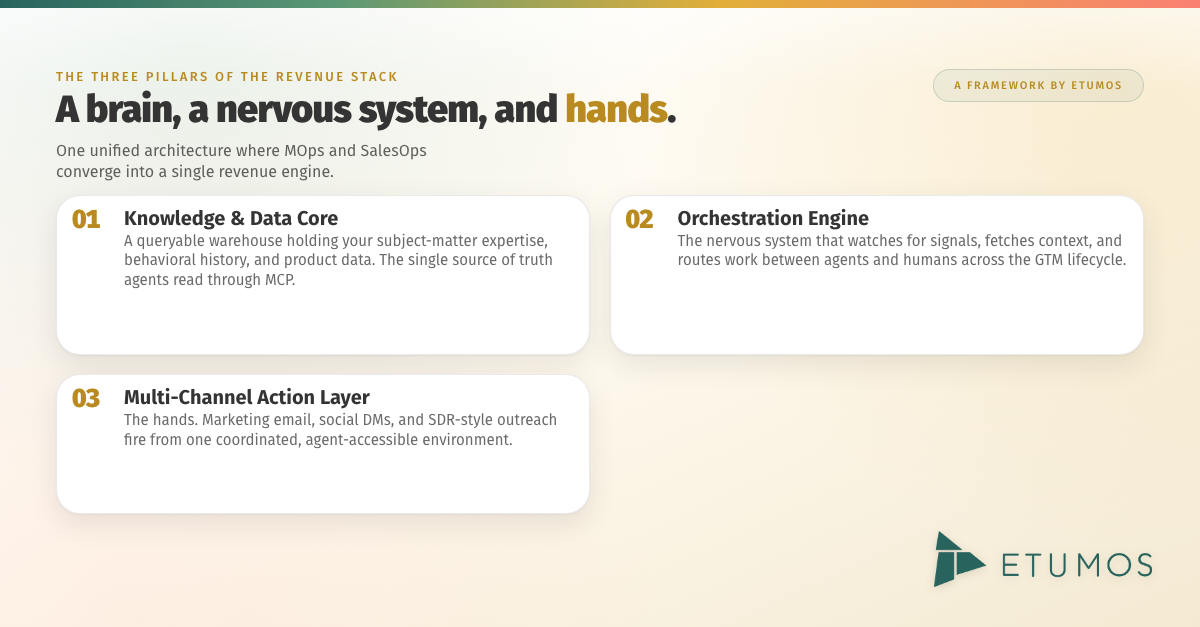
Think of the old stack like a library: a marketer walks in, finds a book, reads it, and writes a letter. The new stack is a high-frequency trading floor. The data is live, the knowledge is stored so an algorithm can query it instantly, and execution happens in milliseconds against pre-set parameters. In that world the line between Marketing Operations and Sales Operations blurs into a single engineering discipline focused on revenue efficiency. Whether you run a traditional enterprise motion or product-led growth, the requirements are identical: you need a brain (data), a nervous system (the orchestration engine), and hands (the action layer).
The Three Pillars of the Revenue Stack
To build a revenue stack that actually moves pipeline, focus on three layers that replace the old silos.
1. The Knowledge and Data Core
The most important part of future-proofing your stack is where you store knowledge and primary company data. This is not just a list of leads in a CRM. It is a centralized data warehouse, Snowflake or BigQuery, that holds your brand’s unique subject-matter expertise, your customer behavioral history, and your product data in one queryable place.
For an agent to be effective it has to be fed the truth. If your knowledge is trapped in PDFs or living in an SDR’s head, the agent falls back on general internet knowledge and you get the generic AI slop everyone is trying to avoid. Centralize that knowledge and you give every agent a single source of truth to query through a Model Context Protocol (MCP), so every outbound message is rooted in factual, company-specific reality.
2. The Orchestration Workflow Engine
Once you have the data, you need a way to move it. This is your workflow engine, the nervous system that coordinates tasks between humans and agents. Tools like Workato, n8n, or a specialized agentic orchestrator act as the routing system for the whole operation.
In a HubSpot or Marketo environment, the engine is what lets you trigger an AI researcher the moment a prospect hits a High Intent lifecycle stage. It sees the signal, pulls the relevant context from the data core, tasks an agent with drafting a personalized LinkedIn message, then hands that draft to a human for a quick QA check before it ships. The signal, the context, and the action all live in one loop instead of three disconnected tools.
3. The Multi-Channel Action Layer
The final pillar is where the work meets the prospect. In a revenue stack the action layer has to be cross-channel and agent-accessible: marketing emails, social direct messages, and SDR-style personal emails firing from a single coordinated environment instead of five tools that do not talk to each other.
The magic happens when your orchestration engine can take action through REST APIs. That is the agentic webhook loop, and it is what closes the gap between marketing and sales for good:
- Trigger: an agentic researcher identifies a signal, for example a target account just hired a new VP of RevOps.
- Analysis: the agent queries the data core for every previous touchpoint with that account.
- Execution: the agent sends a webhook to the action layer, an email API or a social automation tool, with a JSON payload containing the personalized message.
- Closing the loop: the action layer reports back to the data core that the message was sent, enabling real-time attribution and performance monitoring.
That last step is the one most teams skip, and it is the one that turns a pile of automations into a real revenue system. When every action writes back to the core, attribution stops being a quarterly reconstruction project and becomes a live signal you can act on.
Why This Matters for RevOps in 2026
RevOps, SalesOps, and MOps are all collapsing into one function, and the advantage will go to teams that have moved past the black box of third-party AI features to own their own glass-box infrastructure. When marketing and sales share one data core, one orchestration engine, and one action layer, the handoff friction that leaks pipeline simply disappears.
When you build your own AI tech stack for revenue, you are not just buying software, you are building an asset. You can swap out LLMs as they improve without rebuilding your campaign logic. You can scale go-to-market 10x or 100x because the infrastructure is designed for multipliers, not manual labor. Most importantly, you move from being a user of technology to a designer of business systems, which is what keeps a revenue org resilient as the pace of AI keeps accelerating.
How to Rebuild Your Revenue Stack Smarter
Rebuilding core infrastructure is a real undertaking, but you do not rip and replace everything on day one. You build the new world in parallel with the old, one deliberate shift at a time.
- Audit your data silos. Find where your primary-source knowledge is trapped today and start centralizing it in a queryable data warehouse.
- Select your orchestrator. If you are not already running a workflow engine that can talk to APIs, like n8n or Workato, make that your next major acquisition.
- Standardize your logic. Before you let agents run, write clear SOPs. Build your deliverable trees in your project management software first so agents have rails.
- Pilot a cross-channel loop. Start with one tiny use case, like an automated follow-up for webinar attendees that pulls from the data core and fires across both email and LinkedIn.
Frequently Asked Questions
What is an AI tech stack for revenue?
An AI tech stack for revenue is a centralized, modular architecture that runs autonomous agentic workflows across the full go-to-market lifecycle. It rests on three pillars: a knowledge and data core, an orchestration workflow engine, and a multi-channel action layer. Unlike a CRM-centric stack, it assumes agents, not humans, are the primary entities executing work, which is what lets marketing and sales operate as one revenue engine.
How is a revenue stack different from a standard MarTech stack?
A standard MarTech stack is UI-driven: a human logs in and clicks buttons, and the CRM sits at the center. A revenue stack prioritizes machine-to-machine coordination, with a data warehouse as the source of truth and an orchestration engine routing work between agents and people. It collapses MarketingOps and SalesOps into a single discipline focused on pipeline and attribution rather than tool management.
What are the three pillars of an AI revenue stack?
The three pillars are the knowledge and data core (a queryable warehouse like Snowflake or BigQuery that holds your company’s truth), the orchestration workflow engine (the nervous system that watches signals and routes tasks), and the multi-channel action layer (the hands that send email, social, and SDR outreach from one coordinated environment). Together they act as a brain, a nervous system, and hands.
How do I start building an AI tech stack for revenue?
Start by auditing where your primary-source knowledge is trapped and centralize it in a data warehouse. Then select an orchestration engine that can talk to APIs, standardize your SOPs so agents have clear rails, and pilot one small cross-channel loop that pulls from the core and reports back to it. Build in parallel with your existing stack rather than ripping it out.
Stop Patching the Old Ship
The future of revenue technology is being built by teams willing to rethink the foundations of their stack. Engineer a smarter, more integrated infrastructure now and you empower your team to lead the agentic revolution instead of reacting to it. Etumos helps revenue teams build this layer deliberately, from agentic marketing operations to agentic operations across the funnel and a roadmap for agentic revenue operations. If you want to stop patching the old ship and start building the new one, let’s talk.