Look at your marketing org chart today and you will see the same boxes that existed five years ago: demand gen, content, product marketing, marketing ops. Now look at how the work actually gets done. A manager runs a campaign brief through a chatbot, a developer leans on a co-pilot for a script, an analyst quietly automates a report nobody asked her to. AI is already on your team. It just is not on your org chart yet. That gap is the single biggest structural problem in marketing right now.
The tension you feel is not a shortage of tools. It is the lack of a bridge between a powerful large language model (LLM) and your actual, messy Salesforce data or your tangled Marketo request process. Right now most growth-stage B2B companies are running on “random acts of automation,” siloed wins that never compound. To go from using AI to being an AI-powered organization, the marketing org chart needs a new box, owned by a real person: a Head of Applied AI.
Why the Marketing Org Chart Needs a New Box
Think back fifteen years, before marketing operations was a function. Marketing was a collection of creative random acts. Then the MOps leader arrived to build the plumbing, the attribution, and the scale, and the org chart grew a box that is now non-negotiable. The Head of Applied AI is the same kind of arrival, this time for the intelligence layer of the company.
This is not a prompt engineer and not a temporary consultant. It is an internal operator who sits at the intersection of IT, DevOps, business operations, and business intelligence. They shadow your team to watch how a campaign brief travels from a Google Doc into a project management tool, then they bottle that expertise into an agentic workflow that can execute the task on its own. The title can be Head, Lead, or Director. The hierarchy level matters far less than the mandate: own the frontier.
Defining the Head of Applied AI
The Head of Applied AI is a leadership role responsible for auditing internal business systems, finding the gains hiding inside automation, and collapsing manual workflows into repeatable AI modules. They do not configure tools and walk away. They design the roadmap for how knowledge and tasks flow through your organization in a world where agents are about to be as common as employees.
The job sounds abstract until you ground it in a single operating loop. Everything this role does fits into three repeating phases: audit, roadmap, and maintain.
1. Audit and identify the hidden work
A Head of Applied AI does not start with a purchase order. They start by shadowing the practitioners. Watching how your team handles campaign operations or sales support, they build a big list of friction points and look for one specific shape of task: high-frequency, high-logic, low-creativity. Those are the prime candidates to convert into agentic modules.
2. Collapse processes into repeatable modules
Once a friction point is identified, the work gets bottled. A module can be a single agent that handles one task (researching a lead’s recent LinkedIn activity) or a project-level workflow (the full lifecycle of a campaign brief). Consider the sales artifact module: instead of a rep manually building a pitch deck, an agent pulls data from the prospect’s website and your CRM and publishes a one-to-one, joint-branded HTML microsite. The salesperson provides the strategy. The module builds the artifact.
3. Maintain the connections
The AI frontier moves fast. A tool that was best-in-class last Tuesday can be obsolete by Friday. The Head of Applied AI keeps the connections between evolving tools intact, updating internal modules as LLMs improve so the underlying business process never breaks. This is the unglamorous half of the role, and it is the half that keeps your new org chart from rusting.
What the New Roles Actually Do
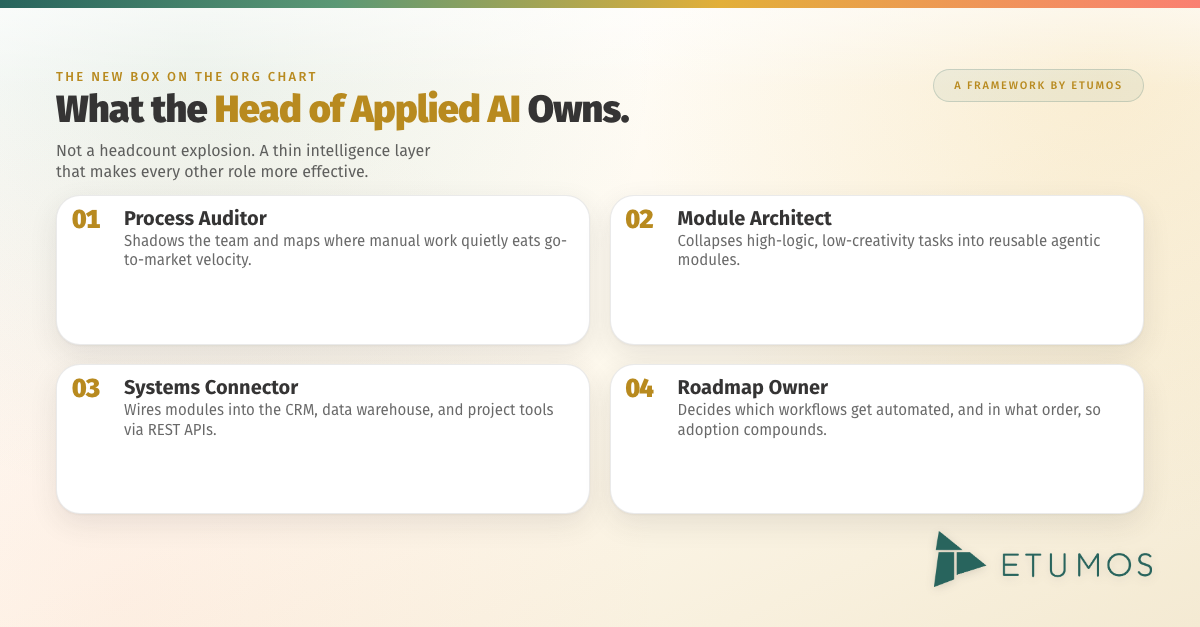
The future marketing org chart is not a headcount explosion. It is the same creative and strategic roles, plus a thin intelligence layer that makes every other box more effective. The five responsibilities below are what that layer owns:
- Process auditor: shadows practitioners and maps where manual labor is silently eating your go-to-market velocity.
- Module architect: collapses high-logic, low-creativity tasks into transparent, reusable agentic modules.
- Systems connector: wires modules into your existing stack (CRM, data warehouse, project management) through REST APIs.
- Frontier maintainer: upgrades modules as models improve without breaking the business process underneath.
- Roadmap owner: decides which workflows get automated, and in what order, so adoption compounds instead of scattering.
How an AI Module Is Built
To turn a manual process into a repeatable module, the Head of Applied AI has to be dev-aware and IT-aware. They are not living in a chat window. They are building multi-step processing chains that talk to your existing APIs. A typical module follows a clean data flow:
- The trigger: a status change in a project management tool such as Jira or Asana.
- Context gathering: the agent queries the data warehouse (for example, Snowflake) for relevant lead or account history.
- The logic gate: an LLM processes the data against a system prompt that encodes your company’s specific best practices.
- The action: the agent hits an API endpoint to create a task, send an email, or update a record.
- The audit trail: the module logs the action back into a central orchestration layer for human review.
Built this way, in discrete steps, the automation stays transparent, auditable, and reusable across the company. That is the difference between a clever one-off and a durable line on the org chart. If you want a partner to stand up that orchestration layer, that is the core of agentic marketing operations.
Why This Matters for the 2026 Org Chart
The Wild West of AI adoption is settling into a permanent frontier. Companies that keep running siloed, manual processes will watch their operating expenses climb while AI-first competitors scale campaigns and outreach almost infinitely. The Head of Applied AI is the insurance policy against that obsolescence. By treating AI as a series of specialized modules instead of a monolithic replacement for humans, you build a hybrid workforce that is smarter, faster, and more effective. You future-proof the business by hiring or empowering a leader who can bottle your team’s genius and scale it with each new agentic improvement. Done well, this reshapes agentic revenue operations across the whole funnel, not just marketing.
Frequently Asked Questions
What is changing on the marketing org chart in an AI world?
The creative and strategic boxes stay, but a new intelligence layer is added, owned by a Head of Applied AI. This role audits internal workflows, collapses repetitive high-logic tasks into reusable AI modules, and maintains those modules as models improve. It is the same structural shift that added marketing operations to the org chart fifteen years ago.
What does a Head of Applied AI do?
They shadow practitioners to find high-frequency, high-logic, low-creativity work, then bottle that work into agentic modules that run through your existing CRM, data warehouse, and project tools. They own the roadmap for which processes get automated and in what order, and they keep modules current as the AI frontier moves.
Do we need to hire a new executive to do this?
Not necessarily. You do need a single person in charge of the frontier. Often it is someone already in your ops or IT team who keeps up with daily AI improvements. The mandate matters more than the title or the seniority level, so you can empower an internal lead before you ever open a new headcount.
How do we start without a full reorg?
Audit one week of your team’s task list, pick a single high-value, logic-based task, and build one module for it (CRM data operations is a common first target). Prove the pattern, then set a formal roadmap for the next workflows. Adoption compounds when it is sequenced instead of scattered.
Start Building the Frontier
The shift to an AI-augmented organization is the most significant change to business systems in our generation, and the marketing org chart is where it becomes visible. Run your internal audit, name your AI lead, build one bottle, and set an implementation schedule so you move past experimentation. The future of operations belongs to teams that can find, identify, and roadmap the transition from manual labor to modular intelligence. If you want help designing that layer, from a first audit to a full agentic operations roadmap, let’s talk.