Open source AI tools have made building feel like a superpower. You describe a workflow to a large language model, and three hours later you have a working prototype: a custom lead-scoring script, a data-normalization agent, something tuned to your exact business logic. Then a week passes. The API docs change, a stakeholder asks for one small tweak, and the superpower quietly turns into technical debt. The question in marketing operations has shifted from “can we build this?” to “should we own this?”
We are no longer limited by our ability to create. We are limited by our ability to maintain. When the underlying technology moves faster than your quarterly roadmap, the decision to build your own solution carries a hidden cost most teams never put into the ROI math.
The New Build vs. Buy Math for Open Source AI Tools
In the traditional software world, the build-vs-buy debate was simple. Building meant high upfront cost for total control. Buying meant lower upfront cost for a standardized feature set. The AI era flipped that on its head. With modern agentic and open source AI tools, the “build” phase has become incredibly cheap and fast, while the “maintain” phase has become exponentially more complex.
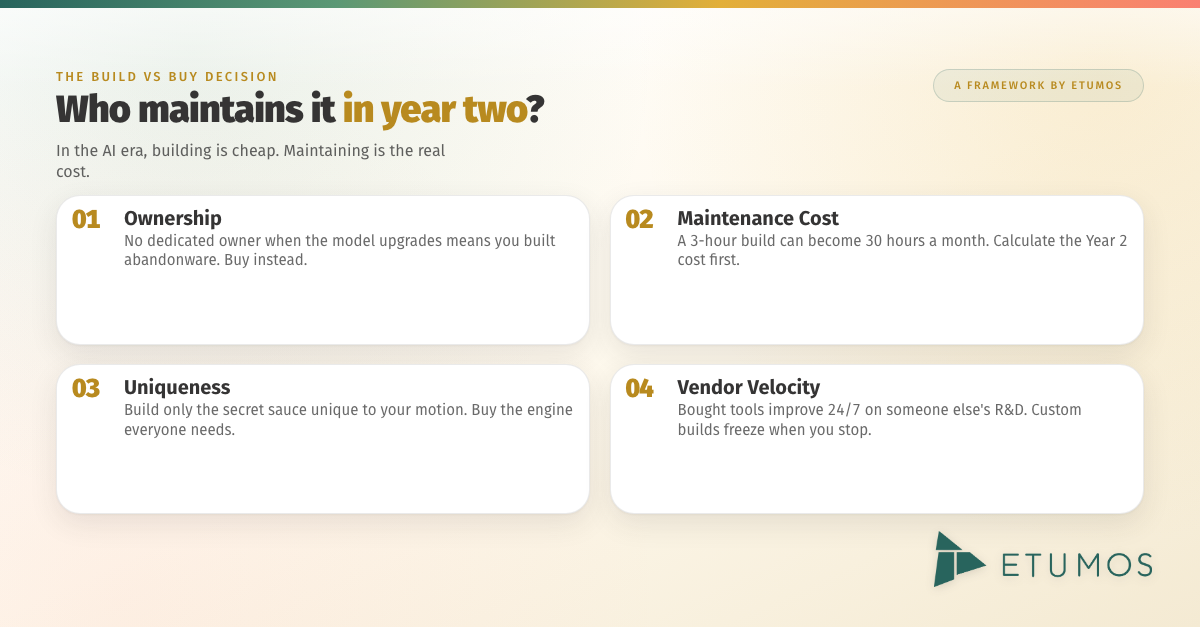
Think of it like building a kit car versus buying a professional-grade vehicle. Build the car yourself and you can customize the engine and interior to your exact spec. It’s a rewarding weekend project, and for a few hours it runs perfectly. But the moment you need a specialized part replaced or the software updated for new safety standards, you are the only mechanic on call. If you aren’t constantly under the hood, that car eventually sits in the garage. In marketing operations, we call that “abandonware”: technology built with high hopes that becomes a liability because no one is dedicated to its ongoing improvement.
When you buy from a dedicated vendor, you aren’t just paying for code. You are paying for an entire team whose only job is keeping that tool at the cutting edge: the weekly LLM updates, the security patches, the integration shifts. You don’t have to.
Why “AI Abandonware” Is the Real Threat
The primary danger of the current AI wave is the ease of creation. Because anyone on a RevOps team can now spin up a “pretty darn good” prototype in a matter of hours, we are seeing a localized explosion of “micro-apps” inside organizations. They solve immediate problems, but they usually lack the governance and scalability that enterprise-grade operations demand.
The Problem With Solo Prototypes
Say you build a custom Python agent to scrape LinkedIn profiles and update job titles in Salesforce. It works perfectly for your first 500 leads. Then your database grows to 500,000 records and the script starts to time out. Because you built it fast and without a deep architectural plan, troubleshooting the memory leaks becomes a full-time job. That is how a three-hour build turns into a thirty-hour-a-month maintenance nightmare.
The Value of Vendor Velocity
When you buy a solution, whether a specialized AI enrichment tool or a robust orchestration layer like Workato, you are buying into someone else’s development velocity. The average B2B SaaS company reinvests roughly 20 to 30 percent of revenue back into R&D. For a marketing ops professional, that means your bought solution gets better around the clock without you lifting a finger. Build it yourself and the feature set is frozen the moment you stop coding.
Before you commit to a custom agent, ask one question: “Who owns this tool six months from now, when the primary LLM model is upgraded?” If the answer is “no one,” you are building abandonware.
When to Build the Modular Layer
Despite the abandonware risk, there is still a real place for custom builds in the modern stack, as long as they are built as modular components instead of monolithic apps. The goal is to build the connective tissue and buy the engine.
How to Build a Modular Webhook Flow
Instead of standing up a separate application, build modular orchestration logic inside the platforms you already run, like Marketo or HubSpot. That lets you tap AI capabilities while keeping the maintenance burden inside a system that is already managed and supported.
The modular build framework has three moves:
- The request: use a standard Marketo webhook to send a data payload to an external AI endpoint.
- The processing: instead of a custom-built app, use a serverless function (AWS Lambda, Google Cloud Functions) to process the logic. These are far easier to maintain and need no server management.
- The response: map the AI’s output back to standardized fields in your CRM.
Build this way and an improved AI model means changing a single line in the serverless function, not re-architecting an entire application. You write the instructions and let the world’s best technology companies provide the infrastructure.
Operational Maturity in 2026
Heading into 2026, the definition of operational excellence is shifting from technical execution to strategic orchestration. High-growth B2B companies are realizing their competitive advantage doesn’t come from the best custom-coded scripts. It comes from the most agile, integrated tech stack.
In a world where 60 to 70 percent of marketing tasks could be handled by autonomous agents, the marketing ops professional’s job is to manage the agentic workforce. That requires a mindset shift. You are no longer just a builder; you are a portfolio manager. You decide which parts of your process are so unique they justify a custom build (your secret sauce) and which parts are better served by the massive R&D budgets of established vendors. Mature organizations minimize their abandonware footprint and maximize their leverage of maintained, evolving platforms. This is the same shift we map across agentic marketing operations and a roadmap for agentic revenue operations.
Frequently Asked Questions
What are open source AI tools in a marketing operations context?
Open source AI tools are freely available models, libraries, and agent frameworks you can wire into your own scripts and workflows, from LLM-backed enrichment agents to data-normalization logic. They make building custom marketing ops automation fast and cheap, but the maintenance burden lands entirely on your team rather than a vendor.
Is it cheaper to build with open source AI tools or buy a vendor solution?
Building is cheaper upfront, often just a few hours of prototyping. Buying is cheaper over time because the vendor absorbs ongoing maintenance, security patches, and model upgrades. Calculate the Year 2 maintenance cost before deciding. If no one owns that maintenance, buying almost always wins.
What is AI abandonware and how do I avoid it?
AI abandonware is a custom-built tool or prototype that becomes a liability because no one is dedicated to maintaining it as models, APIs, and integrations change. Avoid it by assigning a clear owner to every build, auditing your shadow IT regularly, and replacing unmaintained scripts with vendor-supported alternatives.
When does building with open source AI tools actually make sense?
Build when the logic is unique to your go-to-market motion and you can keep it modular, like orchestration logic inside Marketo or HubSpot paired with a serverless function. Buy the engine (enrichment, content generation, system connectivity) and build only the thin connective layer that encodes your secret sauce.
Build the Engine, Don’t Become the Mechanic
Build vs. buy is no longer a one-time event. It is an ongoing strategic choice. To keep your AI strategy from turning into a graveyard of broken scripts, audit your shadow IT and retire what’s becoming abandonware, calculate the Year 2 maintenance cost on every new build, and build modularly while buying centrally. The goal of marketing operations is a reliable engine for growth, not a software development house. Etumos helps teams make that call across agentic operations. If you want to spend your time on strategy instead of fixing yesterday’s tools, let’s talk.