Labeling AI-generated content is no longer a compliance checkbox you bolt on at the end. It is fast becoming the difference between a brand readers trust and one they tune out. You have felt the reason while scrolling your feed or opening a cold email: that subtle, uncanny sense that the words were never really meant for you by a person. Engineers call the equivalent problem “code smell.” In marketing operations, we are learning to name its cousin: “AI content smell,” the overly polished, hollow tone that gives away machine-written copy. Get the labeling right and that smell stops costing you trust.
The tension is a direct result of the agentic shift. We can now produce content at a scale that was once a fantasy, but scale carries a hidden tax: if prospects suspect your insights are recycled training data, your authority evaporates. The fix is not to hide the machine. It is to be deliberate about what you label, how you source it, and what you put your name on.
Why Labeling AI-Generated Content Protects Trust
There is a fundamental loss of trust when a brand pretends a piece is purely human-written and the reader catches the AI smell halfway through. The damage is not that you used AI. It is that you tried to pass it off as something it was not. Labeling AI-generated content flips that dynamic. Think of it like nutrition information on a package: the label does not make the food worse, it tells the buyer exactly what they are getting, so they trust the brand that printed it. The brands winning in 2026 treat disclosure as a feature, not a confession.
What AI Content Smell Actually Is
To be specific, AI content smell is the set of linguistic patterns, predictable structures, and absent point of view that signal a piece was generated without meaningful human input. It is the verbal equivalent of a stock photo: technically perfect, emotionally vacant. In B2B it shows up as posts that summarize a topic without ever taking a stand, or that open with the same “In today’s fast-paced world” preamble we have all grown to loathe.
Using agentic marketing operations intelligently does not mean replacing the chef. It means using high-powered kitchen equipment to serve a thousand people the same high-quality meal the chef designed. The smell appears when you remove the chef entirely and let the machines pick the recipe based on what everyone else is cooking. Labeling alone does not fix weak sourcing, which is why the next two practices matter most.
Best Practices for Labeling AI-Generated Content
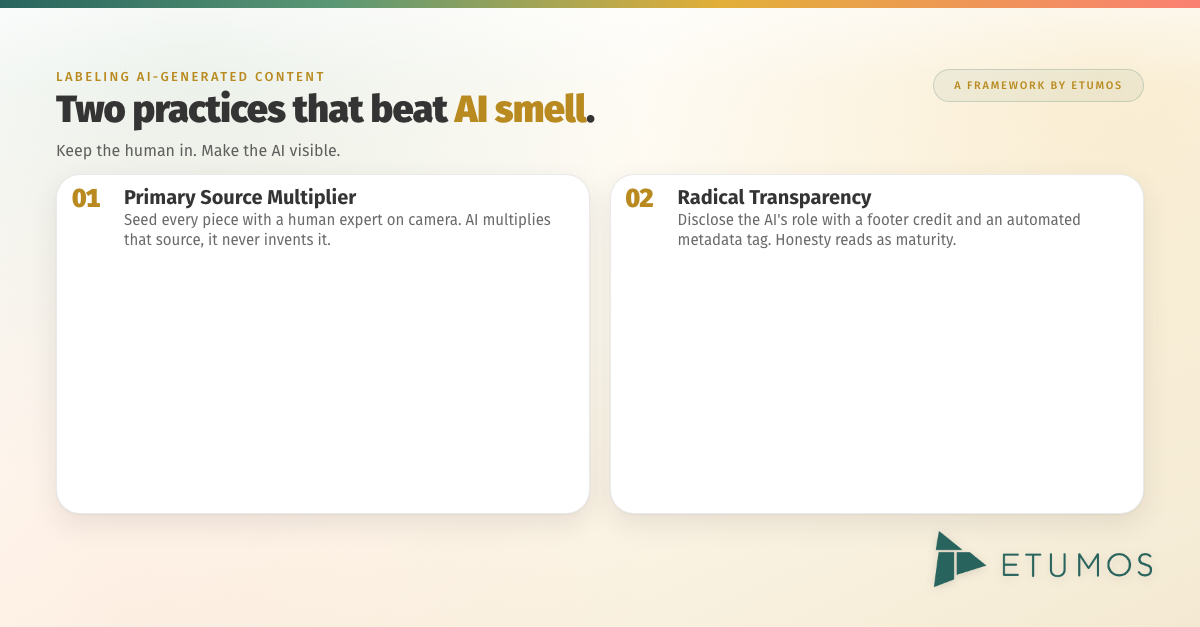
Two practices do the heavy lifting. The first keeps the human in the input. The second makes the AI’s role visible in the output. Together they are how you stay authentic at scale.
Practice 1: The Primary Source Multiplier
The most effective way to eliminate AI content smell is to make sure the seed of your content is 100% human. At Etumos we call this the Primary Source approach. Instead of asking an AI to “write a blog post about lead scoring,” you start with a subject matter expert who has actually sat in the seat and done the work.
The workflow begins by putting that expert on camera or recording a raw conversation. This captures the nuance, the war stories, and the hard opinions an LLM cannot invent because they never happened to it. Take a ten-minute video of your head of RevOps explaining a thorny Marketo-to-Salesforce sync issue. The AI shifts from creator to multiplier, transforming that single source into:
- A polished long-form technical blog post.
- Three 60-second video clips for LinkedIn.
- A series of ten tactical posts for X.
- A summary for the internal newsletter.
Stop starting with a blinking cursor in a chat window. Start with a voice memo or a recorded call. When AI multiplies human knowledge rather than inventing it, you keep your brand’s voice and still hit a far larger execution scale. This is the kind of repeatable build that agentic operations is designed to systematize.
Practice 2: Radical Transparency and the Metadata Layer
The second practice is to stop hiding the machine. Being “AI-enabled” is becoming a mark of maturity, as long as you are explicit about the role AI played. Concretely:
- Naming conventions: use a standard footer such as “Produced with the help of [internal assistant name]” on artifacts the AI helped shape.
- Workbooks and tools: if you send a client a concatenated workbook or a technical audit assembled through AI workflows, state that plainly.
- A content-origin field: add a “content origin” field in your CMS or project tracker that records how much AI was involved, so the label is driven by data instead of guesswork.
Bake transparency into your operations logic. An agentic system drafts from an expert transcript, appends a metadata tag such as <meta name="content-creator" content="AI-Augmented-Human">, and your site template reads that tag to render a “Created with AI assistance” disclaimer in the footer. The label becomes an automated output of the pipeline, not an afterthought someone forgets.
Why Authenticity Is the Currency of 2026
We are watching a flight to quality. Because the marginal cost of producing a generic blog post has dropped to near zero, the value of that post has too. In a world of agentic spam across every channel, authenticity is the one thing that does not scale without effort. Pump out slop and you train your audience to ignore you. Multiply the primary thoughts of your smartest people, label that work honestly, and you build a moat no prompt engineer can copy. The goal is not to be “AI-powered.” It is to be human-driven and AI-multiplied, and to say so out loud.
Your Path to High-Sophistication AI
You can start removing the smell from your marketing right now by changing how you feed the engine:
- Audit your inputs. Look at your last five posts. Were they based on a unique human interview, or did you just prompt an LLM to summarize the topic?
- Set up a recording loop. Book a weekly 30-minute expert interview slot and use it as the primary source for the week’s content.
- Define a disclosure policy. Decide now where your “Created with the help of” labels live and what triggers them.
- Test the multiplier. Take one strong human-written piece and see how many on-brand artifacts an AI agent can create from it without losing the original’s insight.
Frequently Asked Questions
What does labeling AI-generated content mean?
Labeling AI-generated content means disclosing, clearly and consistently, the role AI played in producing an artifact. That can be a footer credit, a “content origin” field in your CMS, or an automated metadata tag and on-page disclaimer. The point is to tell readers what they are getting so the disclosure builds trust instead of eroding it.
Does labeling AI-generated content hurt brand credibility?
No. Credibility takes the hit when a brand hides AI use and a reader detects the AI smell anyway. Transparent labeling, paired with genuine human input, signals operational maturity. Being openly “AI-enabled” reads as sophistication in 2026, not as a shortcut.
How do I label AI-generated content at scale without manual work?
Bake it into the pipeline. Have your agentic workflow append a metadata tag when it drafts from a human source, then let your site or app template read that tag and render the disclaimer automatically. A “content origin” field in your CMS or project tracker keeps the label tied to data rather than someone remembering to add it.
What is the best way to avoid AI content smell?
Start with a 100% human primary source: a recorded expert interview or voice memo. Then use AI to multiply that source into many formats rather than inventing the idea from a blank prompt. Combining real human sourcing with honest labeling is what keeps content authentic at scale.
Make Your Disclosure a Strength
The future belongs to practitioners who can tell the difference between getting it done and getting it right. Pair primary-source sourcing with radical transparency and your marketing stays a trusted source of intelligence in a sea of noise. If you want help building a content operation that multiplies your experts and labels AI work honestly, explore our approach to agentic revenue operations or let’s talk.