
You have probably had that moment of quiet panic: an automated report shows a 400% jump in lead conversion you know never happened, or your routing logic suddenly drops enterprise prospects onto a “do not contact” list. As Large Language Models work their way into lead scoring, personalization, and data normalization, marketing ops teams are inheriting a new kind of technical debt. AI hallucinations are the confident, authoritative lie, and in a revenue system, one of them can quietly break a pipeline you spent years building.
In a creative context a hallucination is a quirky metaphor. In RevOps it is a corrupted record that routes, scores, and reports as if it were true. As we lean harder on AI to run our stacks, learning to contain these errors stops being optional. It becomes a core competency for the modern practitioner.
What an AI Hallucination Actually Is
To fix the problem, you have to understand the engine. A hallucination happens when a model produces output that is unfaithful to the source content while sounding completely certain. Picture a new hire on their first day who has read every business book ever written but has never once logged into your Salesforce instance. Ask them a specific question and they will fill the gaps in what they do not know with whatever sounds statistically probable. That is a hallucination: a plausible guess wearing the costume of a fact.
Inside platforms like Marketo, HubSpot, or Salesforce, the AI draws on two very different sources, and the distinction is everything:
- Context (the hard data): the active memory of what an agent is actually working with right now. Your real lead records, your naming conventions, your campaign IDs. The primary data you hand it through a prompt or an API.
- Background knowledge: the enormous public corpus the model trained on. The internet, books, public documents. This is the AI’s “groupthink” layer.
A hallucination occurs when the model loses its grip on the hard data and silently falls back on background knowledge to fill in the gap. It pollutes your specific, primary data with generic aggregate information scraped from the open web.
Why Hallucinations Are a Governance Problem, Not a Quirk
In marketing operations we do not just ask AI to write catchy headlines. We ask it to process logic. The moment hallucinations enter the logic layer, the downstream effects compound. Ask an LLM to summarize a prospect’s experience path and let it lose pieces of the context window, and it will not stop to ask for help. It guesses what a buyer journey usually looks like, based on its training, and writes that guess into your system as if it were observed fact.
The Problem of Context Window Decay
The context window is the ceiling on how much information a model can hold at once. As you feed in larger and larger sets, say an entire month of activity logs, the model can lose its grip on the specific raw numbers you care about. The hard data sitting at the beginning or middle gets crowded out and replaced by the background groupthink of the model. That is the exact point where garbage starts entering your business systems.
Strategic Flavor Versus Factual Pollution
It helps to sort these errors by impact. Some hallucinations are flavor text: extra strategic layers the model adds that can actually be useful, like noting how your social efficacy compares to a broad industry trend. That is harmless, sometimes even handy.
Factual pollution is the dangerous category. You can never let an AI guess at the number of activities a prospect logged, the products a company bought, or the raw firmographics on a record. Guarding against this kind of invented fact is the line between an AI that scales excellence and one that scales slop.
Designing the Guardrails
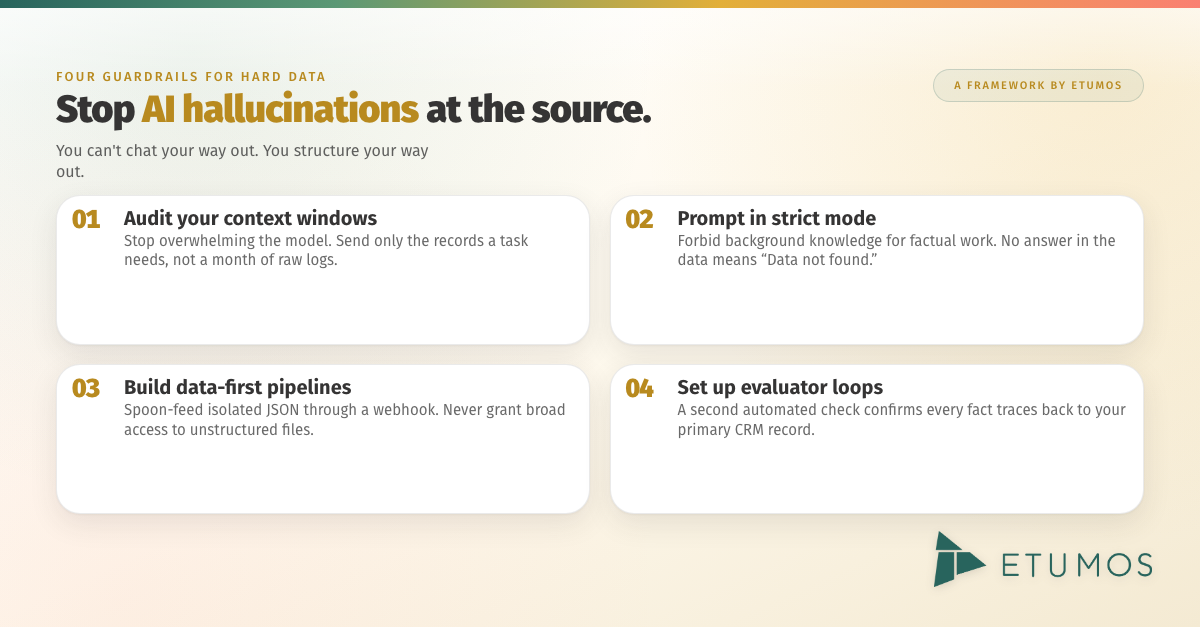
Most hallucinations happen because the model was handed too much creative freedom and too little constraint. The fix is a shift in posture: stop chatting with AI and start structuring your interactions with it. In a mature setup you use a workflow engine like Workato or n8n to govern exactly what data the model can touch. Rather than letting it roam your database, you spoon-feed it specific JSON objects.
- Data isolation: your system queries the CRM and pulls one precise set of lead activity, nothing more.
- Constraint prompting: the prompt is explicit. “Using ONLY the provided JSON, summarize the top three interests. If the answer is not present in the JSON, reply ‘Data not found.’”
- Validation: a second, simpler logic check, or a second agent, compares the output against the original JSON so no background information leaks in.
Force the model to stay inside the bounds of your provided context and you build a glass box, where every output traces cleanly back to a specific piece of primary data. This is the same discipline our team applies across agentic marketing operations engagements: agents earn autonomy only once their data access is governed.
Operational Maturity in the Accountability Phase
The novelty phase of AI is over and the accountability phase has begun. High-growth B2B teams are moving away from general-purpose AI sprawl and toward specialized, governed environments. The goal is to graduate from “we hope the AI is right” to “we built structural certainties that make it right.”
Operational maturity now includes your ability to manage AI hallucinations directly. As agents grow more autonomous, cleaning databases in real time or mapping customer journeys on their own, the cost of a single lie climbs fast. Feed the engine carelessly and you have simply built a high-speed delivery system for garbage. The teams that win treat AI as a processing engine for hard data, not a replacement for factual record-keeping. That principle anchors how we structure agentic operations and the roadmap toward agentic revenue operations.
Frequently Asked Questions
What is an AI hallucination in marketing operations?
An AI hallucination is output that sounds confident and certain but is not faithful to your actual data. In marketing ops it shows up as invented metrics, fabricated activity counts, or wrong routing logic. It happens when the model loses grip on your hard data and silently fills the gap with general background knowledge from its training.
What causes AI hallucinations?
The most common cause is context window decay. When you feed the model too much at once, the specific records you care about get crowded out by the model’s generic training data. The model then guesses what is statistically probable instead of reporting what your data actually says, and it does so without flagging any uncertainty.
How do I prevent AI hallucinations in my MarTech stack?
Audit your context windows so you send only the data a task needs, prompt in strict mode to forbid background knowledge for factual work, build data-first pipelines that spoon-feed isolated JSON through webhooks, and set up evaluator loops where a second step confirms every fact traces back to your CRM record.
Are all AI hallucinations bad?
No. Some are harmless flavor text, like a model noting how your social performance compares to a broad industry trend. The dangerous kind is factual pollution: invented activity counts, products, or firmographics. You never let AI guess at raw facts you already have on record.
Build on Hard Data, Not Hope
Eliminating hallucinations entirely may be a moving target, but minimizing them to the point of insignificance is well within reach. It starts with a mindset shift: stop treating the LLM as a source of truth and start treating it as a logic processor that demands high-quality fuel. The future of marketing operations is agentic, and that future has to stand on a foundation of factual reliability. If you want to design guardrails around the hard data you work with every day, let’s talk.