You have likely felt the ceiling. Your scoring logic stalls inside a single marketing automation platform, your CRM is so cluttered with operational fields that sales can no longer find the “buy” signals, and your data is growing faster than your tools can process it. This is the moment most high-growth B2B teams discover that the “all-in-one” suite has stopped being an asset. The fix is architectural: building RevTech ecosystems that abstract logic away from the execution layer and place it in a high-performance data core.
A RevTech ecosystem is a best-of-breed model where every tool does the one job it does best, coordinated through a centralized data hub. Instead of forcing data science and complex profiling into a platform that was never built for it, you let each layer specialize. The result is a stack that iterates faster, scales further, and never traps your intelligence inside a vendor you might one day leave.
What a RevTech Ecosystem Actually Is
In the modern enterprise, revenue technology has evolved from a pile of siloed tools into an integrated ecosystem. Vendors like Salesforce, Adobe, and HubSpot market their suites as one-stop shops, but the reality for sophisticated companies is different. They run a best-of-breed architecture where each tool performs its specialized function, connected through a shared data layer.
Think of it like a professional kitchen. A home kitchen has one all-in-one appliance that slow-cooks, air-fries, and steams. It is convenient, but it is not the best at any single task. A professional kitchen has a dedicated stove, a walk-in freezer, and specialized prep stations, all coordinated by a head chef. Your cross-system architecture is the kitchen layout. The action layers are the prep stations where work meets the customer. The data core is the central pantry where the real value, your intelligence, is stored and calculated.
The Layers of the Ecosystem
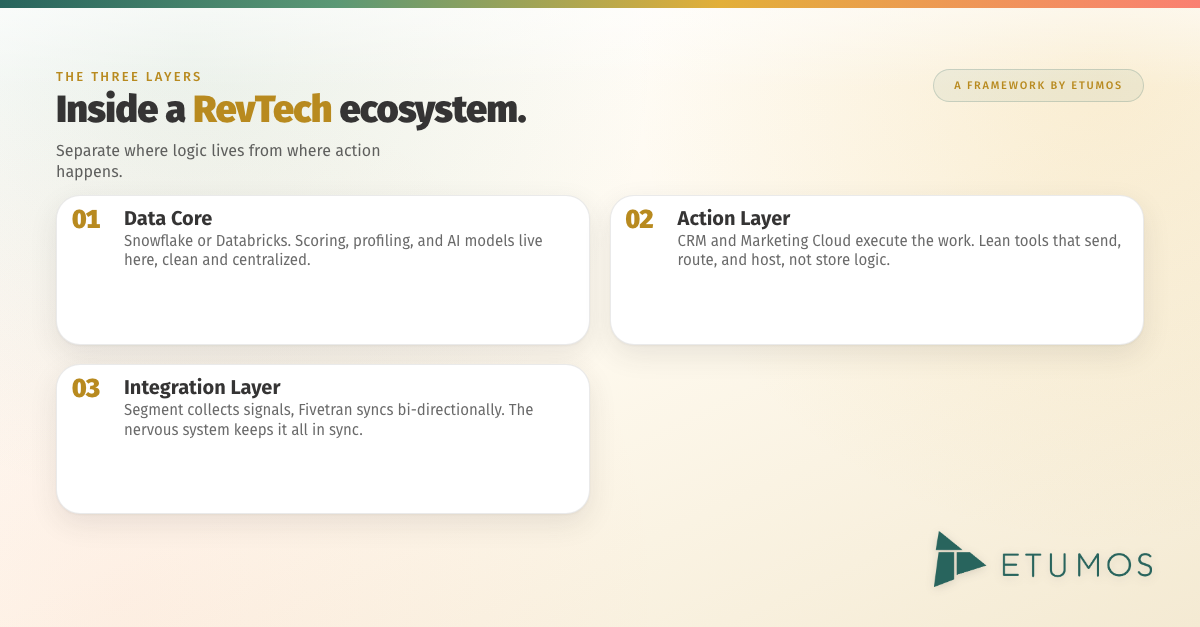
The architecture separates where logic lives from where action happens. Three layers do the work, and keeping them distinct is what lets your data team iterate without breaking customer-facing systems.
The Data Core: Snowflake or Databricks
The foundation is the data core, a combination of data lakes and warehouses that house every interaction, firmographic detail, and behavioral signal. Rather than running a simple lead score inside your MAP, you perform product-interest profiling and advanced scoring directly in Snowflake or Databricks. This abstraction lets data scientists run SQL-heavy or AI-driven models that would crash a standard automation tool. The logic lives in the core, clean and accessible to sales and marketing at the same time.
The Action Layer: CRM and Marketing Cloud
In this model, Salesforce Marketing Cloud or your CRM is treated as an action layer. Its job is to send emails, host forms, and route deals, not to store your primary logic. You build a marketing database inside the data core that calculates audiences and targeting. Instead of a complex “Member of Smart List” filter in your MAP, the data core identifies the audience and pushes it into the action layer as a data extension. The execution tool simply runs the communication, which keeps it lean and your logic centralized.
The Nervous System: Segment and Fivetran
A sophisticated ecosystem needs a reliable way to keep everything in sync. This is where the integration layer earns its keep:
- Segment acts as the collector for web-visit tracking and real-time analytics, pushing behavioral data straight into the data core.
- Fivetran handles the ETL process, ensuring data flows bi-directionally between the data core, the CRM, and the action layers.
How the Bi-Directional Logic Flow Works
The goal is a “Glass Box,” not a “Black Box,” so the data has to move in a deliberate sequence rather than a tangle of point-to-point syncs. Here is the path a single high-intent visitor takes through a well-built ecosystem:
- Ingestion: Segment captures a web form fill and a series of high-value page views, then pushes them to the Snowflake data core.
- Calculation: Snowflake runs a stored procedure or an AI model to update the “Product Interest Profile” and “Lead Score” tables.
- Sync: Fivetran pushes the updated scores into the CRM so sales gets immediate visibility.
- Action: The data lands in the action layer, which triggers a data extension and sends a personalized follow-up.
Because every step is observable and the logic is centralized, you can audit why a lead scored the way it did. That transparency is the difference between a system your team trusts and one they quietly work around.
Why This Shift Matters in 2026
The boundaries between marketing operations and sales operations are dissolving into a broader discipline: Revenue Technology Engineering. Moving toward a true cross-system architecture is not just a technical preference, it is a competitive necessity. When your logic lives in a data core, you future-proof the organization. Swap your email provider or your CRM in three years and you do not lose your scoring models or customer history. They stay safely in your own core.
That modularity is also what makes fast AI adoption possible. You can plug a new intelligence layer directly into your Snowflake data without reconfiguring every downstream tool. High-sophistication organizations are no longer buying tools. They are building proprietary ecosystems that turn data into a permanent advantage, which is the same principle behind a roadmap for agentic revenue operations.
Frequently Asked Questions
What are RevTech ecosystems?
RevTech ecosystems are best-of-breed revenue technology stacks where each tool performs the one function it does best, connected through a centralized data core. Instead of forcing scoring, profiling, and execution into a single all-in-one platform, the architecture separates logic from action so teams can iterate and scale without breaking customer-facing systems.
Why use a data core instead of scoring inside your MAP?
A data core like Snowflake or Databricks can run SQL-heavy and AI-driven models that would overwhelm a standard marketing automation platform. Keeping the logic in the core makes it clean, auditable, and accessible to sales and marketing at once, while your execution tools stay lean and fast.
What tools connect the layers of a RevTech ecosystem?
Segment typically collects web-visit and behavioral data and feeds it into the data core, while Fivetran handles bi-directional ETL between the core, the CRM, and the action layers. Together they form the nervous system that keeps scores, profiles, and audiences in sync across the stack.
How does an ecosystem future-proof a revenue stack?
Because the intelligence lives in your own data core rather than a vendor’s platform, you can swap an email tool or CRM without losing scoring models or customer history. New AI intelligence layers plug directly into the core, so adoption is faster and migrations are far less painful.
Engineer the Connections, Not the Platform
The future of marketing operations is no longer about managing a single platform. It is about engineering the connections between specialized tools so intelligence sits at the core. Start by auditing which scoring and profiling models are trapped inside one tool, then pilot a single campaign driven by your data core instead of your MAP. Etumos helps teams make this move, from agentic marketing operations to broader agentic operations across the revenue stack. If your tech is a collection of disconnected tools and you are ready to engineer a unified ecosystem, let’s talk.