The pace of AI has handed marketing operations a brand-new vocabulary, and a lot of it sounds more complicated than it actually is. This glossary defines the AI buzzwords every marketing ops team is hearing right now, in plain English, with the same analogies we use to explain them to clients. Five terms, no hype.
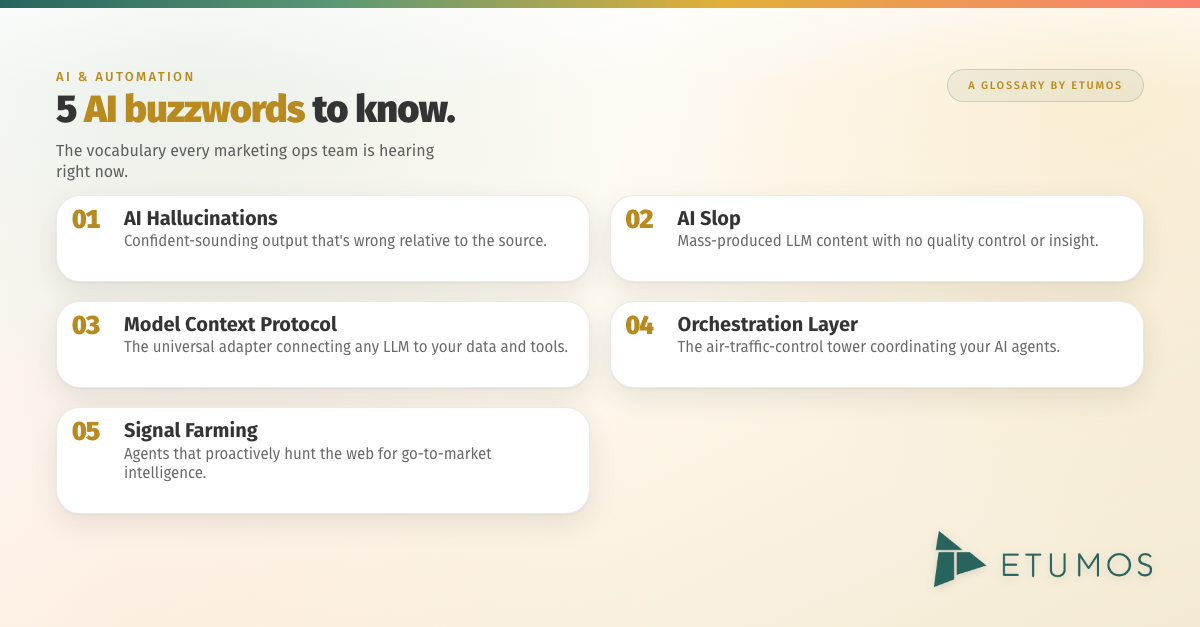
AI Hallucinations
An AI hallucination is when a large language model generates output that is nonsensical or factually wrong relative to the source content, while sounding completely certain.
Think of it like a brilliant intern who has read every business book ever written but has never actually looked at your specific Salesforce instance. Ask a question, and they fill the gaps in what they don’t know with whatever sounds statistically probable from their general knowledge. The danger for marketing ops is the confident tone, not just the wrong answer.
AI Slop
AI slop is the digital equivalent of industrial runoff: the byproduct of using large language models to scale content production at extraordinary speed without quality controls or human oversight.
Think of it like the “pink slime” of the mid-2000s food industry. It technically meets the definition of the product, but it lacks the nutritional value of the original. In a B2B context, it shows up as white papers that summarize common knowledge without a unique point of view, or automated email sequences that read like they were written by a committee of robots.
Model Context Protocol (MCP)
The Model Context Protocol is an open-source standard that lets developers and marketing ops professionals connect large language models to their own data sources and tools. It standardizes how AI “talks” to databases and APIs, removing the need to build a custom integration for every new model that hits the market.
Think of MCP like a universal power adapter for the AI world. Before standardized outlets existed, a lamp from one company and a toaster from another might each need a completely different electrical setup. MarTech has been living in that pre-standardized era, where connecting an AI to a specific SQL database required a bespoke bridge. MCP is the plug that works whether you’re using Anthropic’s Claude, OpenAI’s GPT, or a specialized local model. It breaks into three parts:
- Model (M): the “brain,” the LLM. Because of MCP the model is swappable, so you aren’t married to one vendor and can choose the best intelligence for the task.
- Context (C): the background information: your data, brand guidelines, customer history, and the specific problem you’re solving.
- Protocol (P): the instructions and command structures that govern how the model and the context interact.
Together, the AI gets the “manual” for your business and the “access card” to your data through a single, consistent framework. It’s the standard our own agentic marketing operations work is built on.
Orchestration Layer
An orchestration layer is a centralized software tier that coordinates interactions between AI models, data sources, and your tech stack.
Think of it like an air traffic control tower. Each agent or AI chatbot is a plane trying to land. Without the tower, every pilot makes independent decisions based only on what they can see through their own cockpit window. The orchestration layer is the eye in the sky, directing traffic, managing the sequence of events, and making sure no two actions collide.
Signal Farming
Signal farming is the agentic evolution of social listening: AI agents proactively scan the internet, identify target accounts, and gather deep intelligence against specific go-to-market (GTM) parameters.
Think of it as the difference between a fisherman waiting for a bite on a single line (social listening) and a high-tech farm that uses sensors, drones, and automated harvesters so every plant is nurtured and every crop is collected at the perfect moment.
Frequently Asked Questions
What is an AI hallucination?
An AI hallucination is when a large language model produces output that is incorrect or nonsensical relative to its source material while sounding confident. In marketing ops, it is the model filling gaps in what it doesn’t know with plausible-sounding but wrong information.
What is AI slop?
AI slop is low-value content mass-produced by large language models without quality control or human oversight. It technically resembles real content but lacks original insight, and commonly appears as generic white papers and robotic email sequences.
What is the Model Context Protocol (MCP)?
The Model Context Protocol is an open-source standard for connecting large language models to your data and tools. It acts like a universal adapter, letting you swap models without rebuilding integrations, and breaks into three parts: Model, Context, and Protocol.
What is an orchestration layer in AI?
An orchestration layer is a centralized software tier that coordinates AI models, data sources, and your tech stack, like an air traffic control tower directing multiple agents so their actions don’t collide.
What is signal farming?
Signal farming is the agentic evolution of social listening, where AI agents proactively scan the internet to identify target accounts and gather go-to-market intelligence rather than passively waiting for signals to appear.
Putting These Buzzwords to Work
Knowing the vocabulary is step one; building on it is where marketing ops teams win. Etumos helps teams turn these concepts into working systems, from agentic marketing operations to governed AI workflows on your existing agentic operations stack. If you want a partner who can tell the substance from the slop, let’s talk.