Generative engine optimization is the practice of structuring your content so that AI answer engines like ChatGPT, Claude, and Google Gemini can find, trust, and cite you in their responses. You have spent a decade mastering the Google SERP: the right keywords, clean H1s, the chase for “Position Zero.” But your buyers have quietly changed how they look for answers. They ask an AI for the vendor shortlist, prompt it to summarize a white paper, and skip the blue links entirely. The question is no longer just “can they find us?” It is “will the model cite us?”
That shift breaks a quiet assumption in the 2020 SEO playbook. The “click” used to happen on your site; now it happens inside the chat window, and your visibility depends on whether a crawler could read your expertise at all. If your best content is locked behind a lead-gen form, you are invisible to the model and to the buyer it advises.
What Is Generative Engine Optimization (GEO)?
Generative engine optimization (GEO) is the strategic work of optimizing your digital footprint so large language models can discover, aggregate, and cite your content when they answer a user’s prompt. Traditional SEO drives a human to a webpage through a search engine. GEO feeds the models that power the chat interfaces those humans now use instead.
Think of it as the difference between a library and a personal tutor. SEO makes sure your book sits on the right shelf so a student can find it. GEO makes sure the tutor has actually read your book, trusts your data, and says your name when the student asks for advice. To win at GEO, your expertise has to live where the engines can reach it, not behind a wall.
How Is GEO Different From SEO?
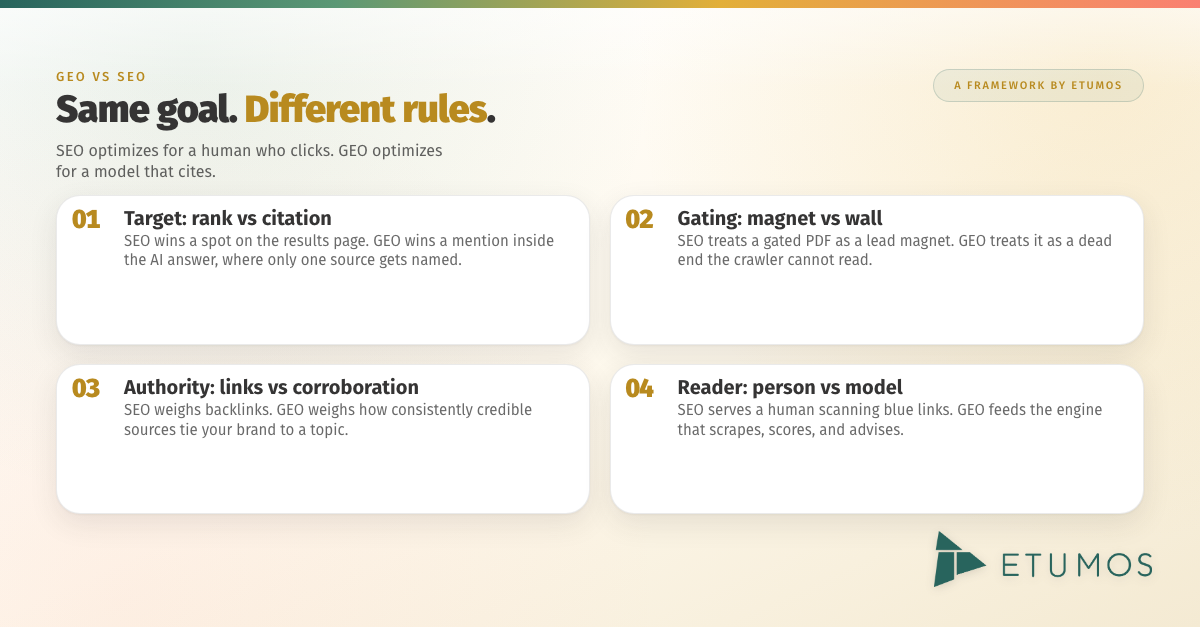
GEO and SEO share a goal (be the answer) but optimize for different consumers. SEO optimizes for a human who clicks a ranked link. GEO optimizes for a model that scrapes, tokenizes, and scores your content for credibility before it ever surfaces your brand. The mechanics diverge in three concrete ways.
- The target shifts from rank to citation. SEO wins a position on a results page. GEO wins a mention inside a generated answer, where there is no page two and often only one source named.
- Gating flips from asset to liability. In SEO, a gated PDF is a lead magnet. In GEO, a gated PDF is a dead end, because the crawler cannot read what it cannot reach.
- Authority comes from corroboration, not just backlinks. SEO weighs links to your domain. GEO weighs how consistently your brand is associated with a topic across credible sources the model already trusts.
This is an operational problem as much as a content one. Winning the citation race is the kind of cross-functional play we map in agentic marketing operations, where content accessibility, technical SEO, and brand authority stop being separate tickets.
How Does GEO Actually Work?
GEO works by earning what amounts to a tokenized reputation inside the model. An LLM does not just match words; it learns relationships between concepts. If your brand name is consistently tied to a topic like “marketing automation best practices” across high-reputation sources, the model builds a strong probabilistic link between you and that topic, and reaches for it when a user asks. The pipeline runs in four steps.
- Discovery: a crawler such as GPTBot visits your site and identifies ungated HTML text it is allowed to read.
- Tokenization: that text is broken into tokens, the mathematical units a model reasons over.
- Knowledge graphing: the engine checks for corroboration, asking whether your brand appears next to the same technical terms on other credible sites.
- Inference: when a user asks “who leads in B2B MarTech consulting?”, the model weighs its internal credibility scores and names the brands it sees cited most and trusted most.
The practical takeaway is unglamorous: make sure your robots.txt allows the AI crawlers, and deliver your technical content as clean, indexable HTML rather than trapping it inside heavy JavaScript or a download form.
The Three Pillars of a GEO Content Strategy
Winning citations takes high-credibility placement, not just high-volume output. Because generative engines favor sources they consider authoritative, your content has to live in environments that carry weight. Three pillars do most of the work.
1. High-Credibility Press Saturation
Press distribution is one of the fastest ways to climb an LLM’s credibility ranking. When you publish an announcement only on your own site, it carries a single domain’s reputation. Syndicate that same factual announcement across reputable news domains, and the model sees it corroborated in multiple trusted places. That repetition raises the odds the engine names you as the primary source on the topic.
2. The YouTube-to-Transcription Pipeline
YouTube has quietly become a GEO weapon. Most major model providers transcribe video to feed their training data, so when you speak with substance on camera you are handing the engines a structured verbal dataset, not just talking to humans. Information-dense, properly transcribed video fills the knowledge gaps a model may have about your niche, fast. This is exactly why Etumos runs a structured pipeline that turns long-form talks into transcribed, indexable assets rather than letting them sit unsearched.
3. Ungated Documentation and Technical Guides
The biggest mindset shift for B2B marketers is toward ungated content. For years we hid white papers and technical guides behind forms as lead magnets. In a GEO world, a gated PDF is a wall the crawler cannot climb, so the engine cannot use your best thinking to answer a prompt. Documentation and genuine “how-to” guides are the content models lean on to give advice. Make your most technical, highest-value material accessible and scrapable, and your brand becomes the one the AI recommends when a prospect asks for help. Pairing that openness with disciplined execution is the heart of agentic operations.
Why GEO Matters for 2026
GEO matters now because the traditional search funnel is collapsing as buyers move to AI-first discovery. The “click” increasingly happens inside the chat interface, not on your website, and AI summaries are replacing the multi-tab research session. A content strategy still built on the 2020 playbook will watch its traffic erode as those summaries answer the question before anyone reaches your page.
Treat GEO as insurance on your brand’s future relevance. In an AI-saturated market the most valuable currency is the citation, and you earn it by saturating the web with ungated, high-quality content across high-credibility channels. Done well, you are not just marketing; you are training the world’s most influential information engines to recommend you. Operational maturity now means managing your reputation for the algorithms that advise buyers, not only for the buyers themselves. That is the same maturity we build into agentic revenue operations.
Frequently Asked Questions
What is generative engine optimization?
Generative engine optimization (GEO) is the practice of structuring and distributing your content so AI answer engines like ChatGPT, Claude, and Gemini can find, trust, and cite it. Unlike SEO, which optimizes a page to rank for a human click, GEO optimizes your expertise to be referenced inside an AI-generated answer.
How is GEO different from traditional SEO?
SEO targets a ranked position so a person clicks through to your site. GEO targets a citation inside a generated answer, where gating becomes a liability and authority comes from how consistently credible sources associate your brand with a topic. The two are complementary, but GEO rewards accessibility and corroboration over keyword placement alone.
Does GEO replace SEO?
No. GEO extends SEO rather than replacing it. You still need clean, indexable, well-structured pages, which is exactly what crawlers like GPTBot read. GEO adds new priorities on top: ungate your best content, allow AI crawlers in robots.txt, and build corroborated authority across press and video so models cite you.
How do I start optimizing for generative engines?
Start by ungating your highest-value technical guides and republishing them as long-form, scrapable web articles. Confirm your robots.txt allows AI crawlers, scale information-dense transcribed video, and use press syndication for major announcements. Then test the engines directly: ask ChatGPT and Claude about your company and your competitors, find the gaps, and create content to fill them.
Your GEO Next Steps
The shift to generative engine optimization is a change in mindset and workflow, and the window to occupy the knowledge gaps before competitors do is open right now. Ungate your technical library, audit your bot accessibility, scale transcribable video, and build a credibility trail through high-authority syndication. The race is to the top of the credibility charts, and the brands that ungate their expertise are the ones the chatbots will name. If your most valuable thinking is still locked behind a form where neither an AI crawler nor your next customer can reach it, let’s talk.