You have spent the last decade building ironclad workflows in Marketo or HubSpot, where every trigger is predictable and every outcome is known. Now the pressure to put large language models and agentic AI to work is mounting, and you are staring at a real trust gap. Human-in-the-loop feels like the safe answer: let the AI draft, then have a person approve every output before it ships. It is a sensible place to start. It is also not where you want to end up.
Automating a “thank you” email is one thing. Letting an agent research prospects, draft social content, or adjust lead scores without a safety net is another. The fear is the black box: run AI unsupervised and you risk brand damage or data corruption. Supervise every task and you have not gained efficiency at all. You have traded a manual task for a babysitting task. To actually scale, you have to stop checking the AI’s homework and start building a deliberate path toward autonomous automation.
The Loop Hierarchy in Marketing Operations
To deploy AI intelligently, you have to define where the human sits in relation to the machine. The industry is fixated on one phrase right now: human-in-the-loop. It means the AI performs a task, but a person must verify and approve the output before it moves forward or reaches production.
Think of it as a student and teacher. The AI writes the essay; the human goes through it with a red pen, fixing grammar and logic before it gets handed in. In a marketing ops context, an agent generates five LinkedIn variations from a webinar recording, and an operator reviews each one and clicks “Post.” Useful, but it is a starting line, not a finish line. The destination for a high-maturity RevOps team is “human on the loop,” where people manage systems instead of reviewing tasks.
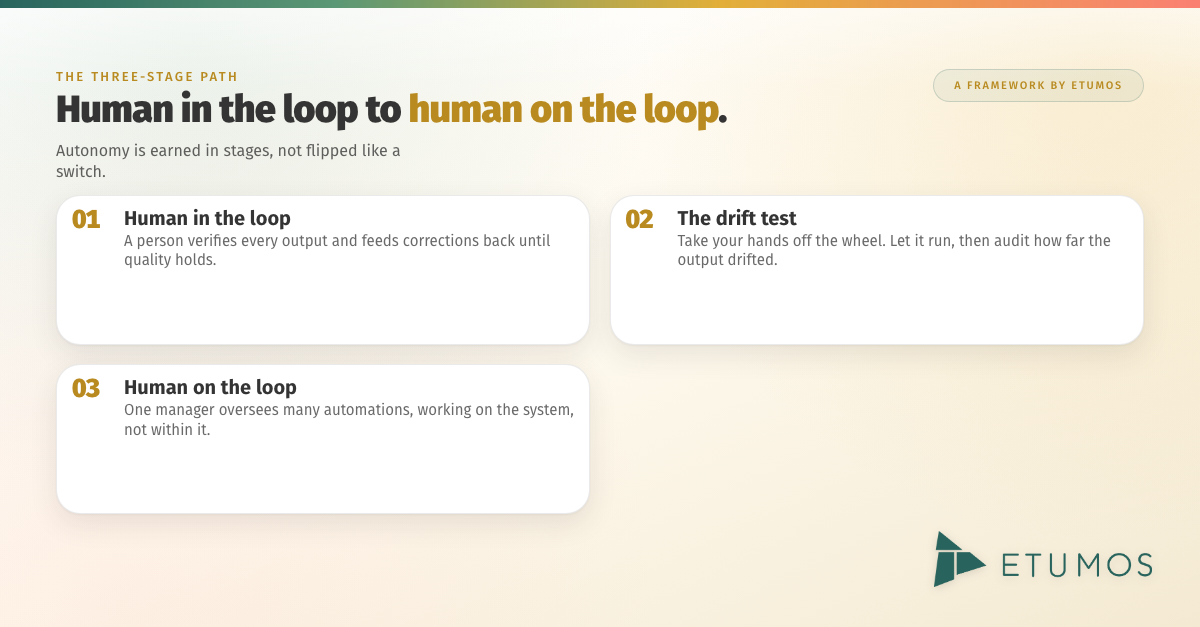
The Three-Stage Path to Autonomous AI
Moving from manual oversight to autonomous execution is a mechanical evolution, not a flip of a switch. You progress from working within the system to working on it, one stage at a time.
Stage 1: Establish the Human-in-the-Loop
At first, every automation gets verified by hand. This stage builds your “reference quality,” the standard the AI is learning to hit. If you ask an agent to categorize leads from their “Contact Us” comments, a human reviews the first hundred entries.
Picture an agentic workflow that summarizes enterprise news for your sales team. Early on, each summary lands in a Slack channel for approval before it posts to the Salesforce account record. The human gives feedback (“this is too long,” or “you missed the revenue numbers”), and that feedback is fed back to sharpen the prompt logic. The goal of Stage 1 is not perfect output. It is a clear, documented definition of what good looks like.
Stage 2: The Hands-Off Drift Test
Once the AI consistently hits the mark, you run a drift test. This is taking your hands off the wheel on a straight, empty highway. You let the automation run on its own for a set window, then audit how far the results drifted from your standard.
When something drifts, you run a root cause analysis. You do not just patch the single error. You find the systemic reason the AI failed and fix that instead:
- The logic: use an “evaluator” model to compare the autonomous output against your gold-standard documentation.
- The signal: when the evaluator finds a discrepancy, like jargon your brand guide forbids, it fires an alert.
- The fix: update the system prompt or the context layer to address the root cause, not the symptom.
Every drift becomes a lesson encoded back into the design, so the same mistake cannot happen twice.
Stage 3: Transition to Human on the Loop
The final stage is where real scale lives. In a human-on-the-loop configuration, no one reviews individual tasks anymore. People monitor a dashboard of many automations at once: health scores, error rates, throughput. Your role shifts from content reviewer to systems architect. You spend your time building new intelligence layers on top of your data warehouse and making sure agents run consistently across the whole organization.
Why Shifting Feedback Left Matters Now
In 2026, marketing moves too fast for human-in-the-loop oversight to survive as the permanent model. As agents gain the ability to click buttons, manage APIs, and run entire campaign lifecycles, the human approval step becomes the bottleneck every time.
Maturity means shifting feedback left: moving quality control into the design of the automation rather than the review of its output. By the end of the road, the human manages the orchestration layer while many autonomous agents run beneath it. Stay stuck in the babysitting phase and you will drown in the volume of AI “slop” that competitors are already learning to filter out through better systemic design. This is the same trajectory we map across agentic marketing operations and into agentic revenue operations, where the work is building the system, not staffing the review queue.
Your Roadmap to Autonomy
The path from human-verified to fully autonomous is a journey of building trust through data. You can start today by treating every manual review as a data point for a future automation:
- Audit your loops. Find every point where a human approves AI work. Are they adding unique judgment, or just checking for typos?
- Run your first drift test. Take one high-performing automation and let it run without approval for 24 hours. Study where it drifted.
- Implement root cause analysis. When the AI errs, change the prompt, the data input, or the rules engine so it cannot recur.
- Define your reference quality. Write a document of “golden responses” the AI can use to self-evaluate.
Frequently Asked Questions
What does human-in-the-loop mean in marketing operations?
Human-in-the-loop means an AI agent performs a task, but a person must verify and approve the output before it moves forward or publishes. In marketing ops, that looks like an operator reviewing AI-drafted posts or lead-score changes before they go live. It prevents reckless errors but is an intermediary stage, not the end goal.
What is the difference between human-in-the-loop and human on the loop?
Human-in-the-loop reviews every individual task before it ships. Human on the loop monitors many automations at once through health scores, error rates, and throughput, intervening only when the system signals a problem. The first is a task reviewer; the second is a systems manager.
What is a drift test and why does it matter?
A drift test is a hands-off audit. You let a high-performing automation run without human approval for a set window, then measure how far its output drifted from your standard. It is the bridge between human-in-the-loop and full autonomy, exposing systemic gaps before you scale them.
How do I start moving toward autonomous automation safely?
Audit where humans currently approve AI work, run a drift test on one trusted automation, and use root cause analysis to fix the system rather than the individual output. Define a set of “golden responses” so the AI can self-evaluate against a clear quality bar.
Take Your Hands Off the Wheel
The future of marketing operations belongs to teams that work on their automations, not within them. Moving from a task-based human-in-the-loop mindset to a system-based human-on-the-loop perspective is how you reach a level of scale and excellence that was not possible before. If you want help mapping that journey across your stack, from agentic operations to a measurable autonomy roadmap, let’s talk.