Agentic workers are the cleanest answer to a problem every RevOps team feels right now: the gap between the scale automation promises and the quality your prospects actually demand. You have seen the “Maturity Zero” version of AI outbound, the spray-and-pray LinkedIn sequence that reads like a robot trying to pass for a human and lands with all the grace of a sledgehammer. That approach burns brand reputation faster than it fills pipeline. There is a better path, and it does not involve handing your outreach to an unsupervised black box.
The fix is to stop treating AI as a spam machine and start treating it as a new kind of hybrid colleague: the agentic Marketing Development Representative, or MDR. You keep the scale of automation without surrendering brand standards, auditability, or the human judgment that closes deals.
What Is an Agentic Worker in Marketing Ops?
An agentic worker is an AI entity, usually powered by a large language model (LLM), built to perform multi-step tasks, make logic-based decisions, and interact with external tools like your email server or CRM. Unlike a standard if-then automation that follows a rigid, linear path, an agentic worker evaluates context. If a prospect replies with a pricing question, the agent does not blindly fire “Email 3” in the sequence. It identifies the intent, pulls the relevant data, and crafts a specific response.
Think of the difference between an automated sprinkler and a professional gardener. The sprinkler turns on at 6:00 AM whether or not it is raining. The gardener checks the soil, reads the forecast, and decides which plants need water and which need pruning. In marketing operations, agentic workers move you beyond the calendar-based “four email drip” and toward an event-based, concierge-style engagement model where AI handles research and first-touch communication while staying under human strategic guidance.
Transforming SDR Outreach Into an MDR Concierge
The most immediate use case for a hybrid workforce is building a Marketing Development Representative. In a traditional org, an MDR is a high-cost human hire tasked with following up on marketing-qualified leads and nudging them toward a sales conversation. With agentic workers you can deploy that “content concierge” at a fraction of the cost, and without the risk that comes with unmonitored cold outbound. The point is not to replace your reps. It is to give every lead the attentive first touch your team would deliver if it had unlimited hours, which is how agentic marketing operations scale human intelligence instead of just automated volume.
Trigger Outreach With Lifecycle Stages, Not Guesswork
The secret to outreach that feels intelligent is tight coordination with your marketing automation platform (MAP), whether that is Marketo or HubSpot. Instead of letting an agent guess who to email, you use lifecycle stages as the primary trigger.
A practical example: when a lead’s status moves from MQL to Sales Accepted Lead, or when they cross a lead score threshold by downloading a high-intent technical guide, a webhook fires to the agentic layer. This is not a random cold call. It is a triggered event. The agent sees that the prospect just engaged with a specific topic and reaches out as a concierge to offer a related white paper or a technical consultation.
Turn the Black Box Into a Glass Box
One of the biggest hurdles to AI adoption is the black box problem: you cannot see what the AI is doing until a prospect complains. You fix this by wiring the agent directly into your corporate email infrastructure.
Instead of sending from a hidden, third-party server, the agent sends through a specific, monitored internal inbox. That turns the process into a glass box. Because the messages live in your standard sent folder and get BCC’d into Salesforce or HubSpot, you keep a complete audit trail. You can see exactly what your agentic workers are saying, which makes real-time human learning and logic adjustments possible. Visibility, not blind trust, is what makes the system safe to scale.
The Agentic Webhook Flow, Step by Step
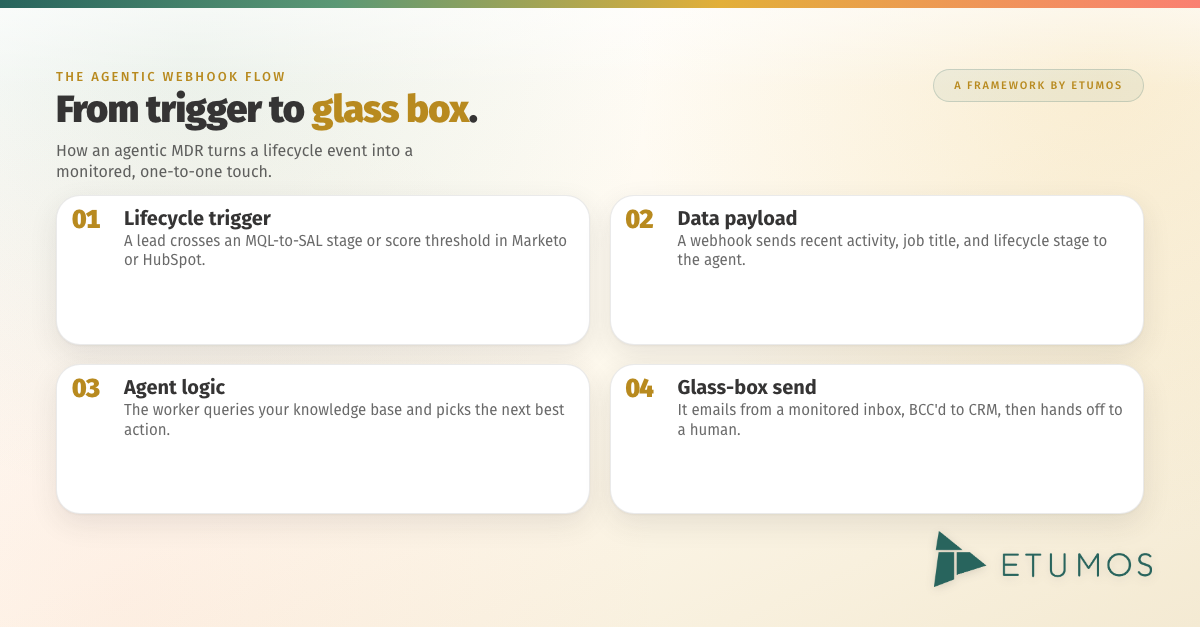
Making this work requires a deliberate trigger-to-agent architecture. This is not a native feature you toggle on. It is a coordinated flow between your MAP and your agentic orchestration layer (Workato, n8n, or a custom Python agent). Here is the loop:
- The trigger: a lead hits a specific trigger smart campaign in Marketo based on activity, for example “visited the pricing page three times in 24 hours.”
- The data payload: Marketo sends a webhook to your agentic worker carrying the lead’s recent activity, job title, and current lifecycle stage.
- The agent logic: the worker receives the webhook, queries your internal knowledge base (via RAG or a Model Context Protocol), and determines the next best action.
- The execution: the agent logs into the designated MDR inbox via API (Microsoft Graph or the Gmail API) and sends a personalized, one-to-one message.
- The feedback loop: if the prospect replies, the agent reads the sentiment, and on a positive signal it hands off to a human SDR to take over.
Scaling Without Losing the Human Touch
As the 2026 landscape takes shape, the teams that win will scale human intelligence rather than raw automated volume. We are entering an era of hybrid workforces, where headcount is not a count of desks but a blend of human strategists and agentic executors.
This matters now because Maturity Zero outreach is losing its punch fast and prospects are going AI-blind to generic sequences. Move instead to a Maturity Three model, where agents follow human-designed standard operating procedures (SOPs) and act as a concierge rather than a hunter. You use AI for the research and first-touch outreach that is usually too expensive for humans to do well, which frees your reps for the high-value closing work only they can do. That is the heart of a healthy agentic revenue operations motion.
Deploy Your First Agentic MDR
Moving to an agentic model does not demand a total tech-stack overhaul. It demands a focused build experiment. Start by standing up an MDR concierge for a single high-value campaign:
- Define your concierge SOP: do not just hand an AI a prompt. Write a standard operating procedure that spells out how it introduces itself, what resources it can offer, and exactly when it hands off to a human.
- Set up a monitored inbox: create a dedicated address for the agent (for example, concierge@yourcompany.com) and make sure your MOps team has full access to watch the outgoing glass-box communications.
- Identify a lifecycle trigger: pick one lifecycle stage or lead-score threshold that currently lacks consistent human follow-up.
- Build the audit trail: ensure every email the agent sends logs automatically into your CRM so sales has full visibility into the conversation.
The future of marketing operations is agentic, but it is a future driven by human strategy and auditability. By moving outreach into a visible, triggered framework, you empower your team to provide a one-to-one experience at one-to-one-thousand scale.
Frequently Asked Questions
What is an agentic worker in marketing operations?
An agentic worker is an AI entity, usually powered by an LLM, that performs multi-step tasks, makes logic-based decisions, and interacts with tools like your email server and CRM. Unlike a rigid if-then automation, it evaluates context, so it can read a prospect’s reply, identify intent, and craft a specific response rather than firing the next email in a fixed sequence.
How do agentic workers improve outbound prospecting over generic AI sequences?
Generic “Maturity Zero” sequences blast the same drip to everyone and prospects tune them out. Agentic workers trigger off real lifecycle stages and intent signals, so outreach arrives as a relevant concierge follow-up tied to something the prospect just did. That shift from spray-and-pray to event-based engagement protects brand reputation and converts far better.
What is the glass box approach and why does it matter?
The glass box approach routes agent emails through a monitored internal inbox instead of a hidden third-party server, and BCCs every message into Salesforce or HubSpot. That gives you a complete audit trail of what your agentic workers are saying, which lets you correct logic in real time and scale the system without the risk of an unsupervised black box.
How do I start using agentic workers without overhauling my tech stack?
Run a focused build experiment on one high-value campaign. Write a concierge SOP, set up a monitored inbox, pick a single lifecycle stage or lead-score threshold that lacks consistent follow-up, and log every agent email into your CRM. From there you expand to more triggers once the audit trail proves the model works.
Build the Hybrid Workforce
How much pipeline is sitting in your MQL stage right now simply because your human SDRs do not have time to give every lead a concierge-level follow-up? That is the gap agentic workers were built to close. Etumos helps teams design the SOPs, triggers, and glass-box guardrails that make agentic outreach trustworthy, from agentic marketing operations to a roadmap for agentic revenue operations and the broader build work of agentic operations. If you want a hybrid workforce that scales human intelligence instead of automated noise, let’s talk.