
If you run Marketo and you keep hearing that you need to be “AI-ready,” here is the most useful first move you can make: build a prospect context ball. A prospect context ball is a single large text or JSON field on the lead record that bundles everything you would want an AI to know about a person before it researches them, scores them, or recommends a next action. It is not a new product, a new license, or a platform you are waiting on. It is an operational program you can build in Marketo today.
The reason this matters is simple. When you want a large language model (LLM), an agent, or a chatbot to come up with insightful research and action on an individual prospect, the hard part is not the model. The hard part is handing the model clean, curated context without a tangle of cross-object lookups. The context ball solves that. You write the relevant data into one field, then pass that one field to the model.
What a Prospect Context Ball Actually Is
Picture one field that lives directly on the lead record. Edward Unthank, Solutions Architect at Etumos, has been describing this approach for more than a year: a large text-area field (treat it as a JSON field) that contains all of the information about an individual lead, contact, or company that you want to pass into an LLM. Because it is JSON, you can nest dynamic fields inside it and keep a predictable structure that a model can read.
The point of consolidating everything into one field is to avoid “a bunch of crazy cross-object lookups” every time you want to talk to a model. Instead of stitching activity, scoring, and profiling together at query time, you maintain them in the field continuously. Then you can spin that field off into an LLM endpoint without major cross-object craziness.
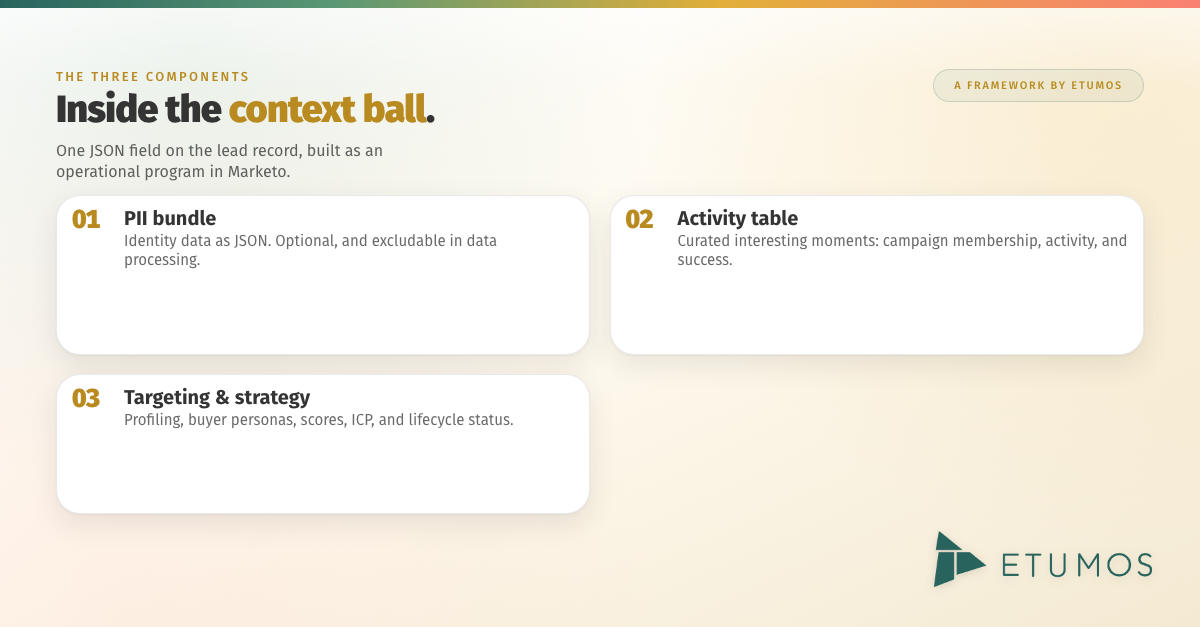
The Three Components of the Context Ball
The context ball is not one undifferentiated blob. It has multiple components, and each one is just a lead field you write to with an operational program. Edward breaks it into three.
1. The PII Bundle (lead.PII)
The first component is a context bundle specific to personally identifiable information: name and the other identity fields you would want a model to see, structured as JSON. This part is optional. In your data processing you can make sure PII is not necessarily included everywhere, so you stay in control of what gets passed downstream and what does not. If a given workflow does not need identity data, you exclude it.
2. The Activity Table (lead.activity)
The second component is curated activity, concatenated into one large field. The key word is curated. You are not dumping raw behavioral logs into the model. You are cherry-picking the most relevant activity, the way Marketo and Salesforce practitioners already think about “interesting moments.” An interesting moment is a prospect action relevant enough to change and inform the sales conversation. If it is worth surfacing to a human rep, it is worth surfacing to the model.
What goes in here is the activity an LLM is approved to see and would find useful: campaign membership, campaign activity, and campaign success, concatenated as JSON. You deliberately leave out the noise. You do not want the model to remark on someone reloading the home page every few days because a background tab kept refreshing. You build operational programs (think of them as compilers) that watch for genuine interesting moments and concatenate them into the activity field as they happen.
3. Targeting & Strategy (lead.targeting)
The third component is the strategic layer: profiling, buyer personas, scores, and your overall targeting strategy. This is where you write everything about how you actually segment and prioritize a person. In a B2B context that typically means ICP, product interest, use-case profiling, customer vertical at the company level, and lifecycle status. Take each of those individually, build an operational program that creates and maintains its field, and keep it up to date as the prospect changes.
How You Build It in Marketo Today
This is the part worth repeating: you can do this right now, and you do not need to pay Marketo or anyone else for a new module to do it. The context ball is an operational program that writes to a large field.
- Set up smart campaigns that watch for changes in each subset (each targeting attribute, each interesting moment, each relevant score).
- Write each change into its field, then roll those fields up into the larger concatenated context fields (the prospect context balls).
- Keep it maintained automatically so the field stays current for each individual prospect as their behavior and profile evolve.
- Curate, do not flood. Scoring inputs like a lead score can be powerful, but they get noisy and useless fast if you pick the wrong signals. Choose the points that actually inform the conversation.
Once the field is populated, you hand the whole thing to a model. You can pass it to an LLM and ask for suggestions (“here is what we calculated, can you come up with better targeting?”), or feed it into an orchestration layer such as LangChain or n8n so an agent can take individual action. For a more business-user-focused workflow, the same field drives next recommended asset and next recommended action.
Why This Is the Right First Step
Most teams stall on AI because they try to point a model at a messy database and hope for insight. The context ball flips that. It uses the data infrastructure you already have in Marketo, curates it into a few operational fields, and gives you one clean handoff point to any model or agent. It also doubles as an approval mechanism: by deciding what gets written into the field, you decide which data is processed and passed to the other system.
If you are still running Marketo, this is how you start testing real hypotheses about doing marketing better with AI: targeting and profiling calculated by large language models, off context you control. This is the foundational pattern Etumos uses when we bring teams into the agentic era, whether through agentic marketing operations, broader agentic operations, or a full agentic revenue operations roadmap.
Frequently Asked Questions
What is a prospect context ball?
A prospect context ball is a large text or JSON field on the Marketo lead record that bundles everything you want an AI to know about a prospect: a PII identity bundle, curated activity, and targeting and strategy data. You build it with an operational program so you can pass one clean field to a large language model instead of running many cross-object lookups.
Do I need a new Marketo feature or license to build one?
No. The context ball is an operational program that writes to a large field you already have. You set up smart campaigns that watch for relevant changes and concatenate them into the field. You can build it right now without paying for an additional module.
What are the three components of the context ball?
First, an optional PII bundle (identity data you can exclude in data processing). Second, an activity table of curated “interesting moments” such as campaign membership, activity, and success, concatenated as JSON. Third, a targeting and strategy layer covering profiling, buyer personas, scores, ICP, and lifecycle status.
How does the context ball connect to an LLM or agent?
Once the field is populated, you pass it whole to a large language model for suggestions, or into an orchestration layer such as LangChain or n8n so an agent can take action. Because the relevant data is already concatenated, you avoid cross-object complexity and the field also acts as an approval gate for what data is processed.
Build It This Week
You already have the tool to do this. The context ball turns your existing Marketo data into something an AI can actually reason over, and it is the cleanest on-ramp to next-best-asset and next-best-action workflows. If you want help designing the operational programs that build and maintain it, let’s talk.