You know the moment. You hover over the “send” button on a new AI-driven automation, a lead scoring model or an automated outreach sequence, and a quiet hesitation creeps in because you cannot see the “why” behind the output. In marketing operations we are trained to demand transparency. We need to know exactly why a lead routed the way it did and why a score changed. LangChain exists to give you that visibility, and it is fast becoming the orchestration layer that turns opaque AI into auditable, repeatable logic.
Most standard AI tools feel like a black box. You put a prompt in, a result comes out, and the reasoning in between stays a mystery. That is fine for a one-off experiment. It is a dealbreaker the moment you want to run AI as a core function. If you cannot audit the steps, you cannot trust the results at scale. The fix is a level of abstraction that converts those opaque processes into a “glass box” of visible, repeatable steps.
What Is LangChain, and Why Does MOps Need It?
LangChain is an open-source framework built to simplify applications powered by large language models (LLMs). A standard chatbot like Claude or ChatGPT handles one-shot prompts. LangChain works one level up, as a coordination and orchestration layer. It lets you chain together different components, including multiple LLMs, databases, and search tools, to build complex, multi-step agentic workflows.
Think of the difference between a freelance writer and a managing editor. A standard LLM is the writer: hand them a topic and they produce a draft. LangChain is the managing editor: it knows which writer to assign to which task, researches the background first, checks the draft against your brand guidelines, and routes the finished piece to the right channel.
In a corporate environment, LangChain provides the harness required to manage multiple agents. Instead of a dozen disconnected AI tools, you get one centralized system that coordinates their actions, exposes their decision-making, and produces the analytics you need to improve over time. It is the path forward for any team that wants flexibility, future-proofing, and real auditability in its AI operations.
Moving From Black Box to Glass Box Operations
The biggest problem with a single-purpose AI interface is that it flattens the research and coordination steps. Ask an agentic AI to “research this prospect and draft a plan” and a black-box system might just hand back the final plan. You have no idea which sites it visited, which data it prioritized, or where it made a logical leap.
The Role of the To-Do Agent
With LangChain you can build a multi-agent system where a high-level abstraction, the “To-Do Agent,” runs the primary orchestration. This lead agent breaks the zoomed-out goal into individual research steps, then assigns those sub-tasks to specialized agents. One agent focuses on LinkedIn research, another on financial report analysis, each doing the narrow job it does best.
Because these steps are chained together visibly, you can see each research outcome before the final draft is compiled. That transparency lets your team pinpoint exactly where a process is drifting or failing, which turns a mysterious output into a series of repeatable, improvable actions.
The Anatomy of a Technical Chain
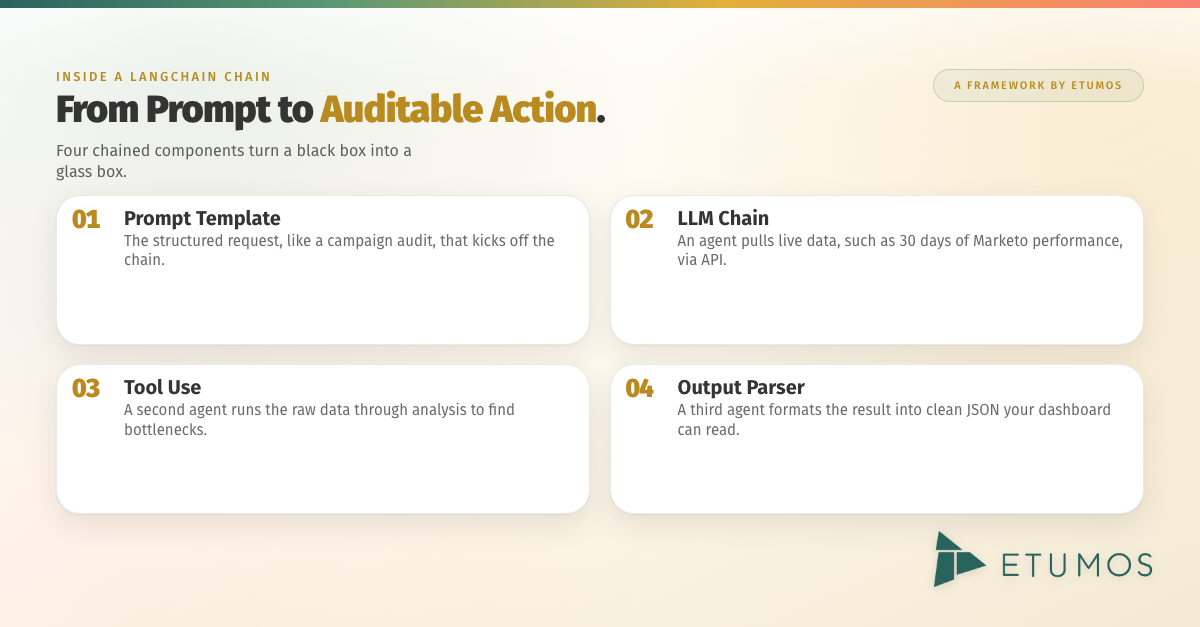
From a practitioner’s seat, LangChain manages the state and memory of a workflow across multiple tools. In a typical Marketo or HubSpot environment, you might use it to bridge the gap between your CRM and your AI agents. A campaign audit chain could run like this:
- Prompt template: the user requests a campaign audit, and the chain begins.
- LLM chain: Agent A uses the Marketo REST API to pull the last 30 days of campaign performance data.
- Tool use: Agent B runs that raw data through a Python analysis step to find conversion bottlenecks.
- Output parser: Agent C formats the analysis into a structured JSON object that updates a dashboard in your data warehouse.
This coordination means the agent is not guessing from training data. It is executing research on the LLM layer in a way that is consistent and auditable. The same pattern underpins how we build agentic marketing operations that a team can actually trust.
Orchestration as Future-Proofing
Looking toward the 2026 landscape, the primary layer of LLMs (Claude, OpenAI, Gemini) will keep evolving and multiplying. New companies will spin up specialized agents for nearly every niche task imaginable. If your strategy is tied to a single app’s interface, you are building a silo with an expiration date.
The value of an orchestration layer is that it makes your AI infrastructure modular. You can swap the brain of an agent as better models ship without rebuilding your entire workflow. You also get the visible analytics that B2B organizations demand: you can see what people ask for, find where agents struggle, and build sub-features to fill the gaps. That modularity is the same discipline we bring to agentic operations across the go-to-market stack.
Today this approach is genuinely technical. It lives in the developer world rather than being a perfectly plug-and-play business tool. Until a business-level harness arrives that offers the same flexibility, LangChain remains the gold standard for holistic orchestration. It lets MOps leaders run the agentic race without losing control of the logic or the data.
Building Your Centralized Orchestration Layer
Moving toward an agentic workforce means trading simple prompts for structured orchestration. When you centralize your agents inside a framework, your AI operations become as transparent and accountable as your human teams. Start with four moves:
- Audit your black boxes. Find the AI tasks running today with no visibility into the sub-steps. Those are your prime candidates for a multi-agent chain.
- Define the lead-agent logic. Before building, map the to-do list an agent should follow for a complex task. What research is required? What tools must it reach?
- Invest in technical upskilling. Because this is a dev-centric approach, prioritize Python and LLM-orchestration training for your technical MOps members.
- Centralize your analytics. Log every agentic action and conversation so your team can review and improve the system, not just run it.
Frequently Asked Questions
What is LangChain in simple terms?
LangChain is an open-source framework that coordinates large language models, databases, and tools into multi-step workflows. Where a chatbot answers one prompt at a time, LangChain acts as the orchestration layer that chains several agents and tools together so a complex task runs as a visible, auditable sequence rather than a single black-box output.
Why does marketing operations care about an orchestration layer?
MOps teams need to explain why a lead routed or a score changed. An orchestration layer like LangChain exposes each step an agent takes, turning a black box into a glass box. That visibility is what lets you trust AI at scale, audit its decisions, and improve the workflow instead of guessing at why an output looked the way it did.
Do I need to be a developer to use LangChain?
For now, largely yes. LangChain is a dev-centric framework, so getting full value usually means Python skills and some orchestration knowledge on your technical MOps members. Business-friendly harnesses are emerging, but until one matches this flexibility, plan to upskill a technical owner or partner with a team that handles the orchestration layer for you.
How does LangChain future-proof my AI strategy?
It makes your stack modular. Because agents are coordinated through the orchestration layer rather than locked into one app, you can swap in a better model as it ships without rebuilding the workflow. You also keep centralized analytics on every agent action, so your AI infrastructure can adapt as the model landscape changes rather than becoming a silo you have to replace.
Build the Layer, Not Another Silo
The future of corporate AI is not about finding the one perfect agent. It is about building the best orchestration layer to manage all of them. Adopt a glass-box philosophy now and your revenue engine is built for scale, transparency, and the improvements still coming. Etumos helps teams design exactly that, from agentic marketing operations to a roadmap for agentic revenue operations. If you want a modular orchestration layer instead of a new black box, let’s talk.