Done well, agentic deployment is the difference between a company that scales output and one that just scales noise. You have likely felt the squeeze: your to-do list keeps growing while your headcount stays flat. In marketing operations, the number of campaigns you can launch has always been tied, almost linearly, to the number of human hours you have to spend executing them. Your tools are “automated,” sure, but a person still babysits every trigger, every filter, every data sync. The real question is not “which tool do I buy next?” It is how you deploy an agentic workforce so it multiplies your best people instead of flooding the market with generic output.
The unit of labor itself is changing. Scaling no longer has to mean hiring more people to run manual tasks. It can mean giving autonomous agents real roles, with real job descriptions, and pointing your humans at the strategy only they can do.
What an Agentic Workforce Actually Is
An agentic workforce is a hybrid team: human strategists plus autonomous AI agents that own specific roles and responsibilities. Unlike traditional automation, which follows a rigid “if this, then that” script, an agentic worker can reason through a task, use tools, and adjust based on the goal it was handed.
Think of the difference between a calculator and a junior analyst. A calculator returns an answer only if you supply the exact inputs and operations. A junior analyst can be told, “research our top three competitors’ pricing and summarize the gaps,” and will figure out where to find the data, how to structure the report, and when to ask for clarification. Deploying agents means giving each one a “hat”: a Recruiter Agent, a Data Operations Agent, a Content Concierge. Treat AI as a member of the workforce rather than a feature in a software package, and you move from efficiency gains to a real transformation in output.
Agentic Deployment Strategies by Company Size
There is no single roadmap. The right approach to agentic deployment depends on the one variable that shapes everything else: your headcount and complexity. A 10-person startup uses agents in a fundamentally different way than a 500-person enterprise must manage them.
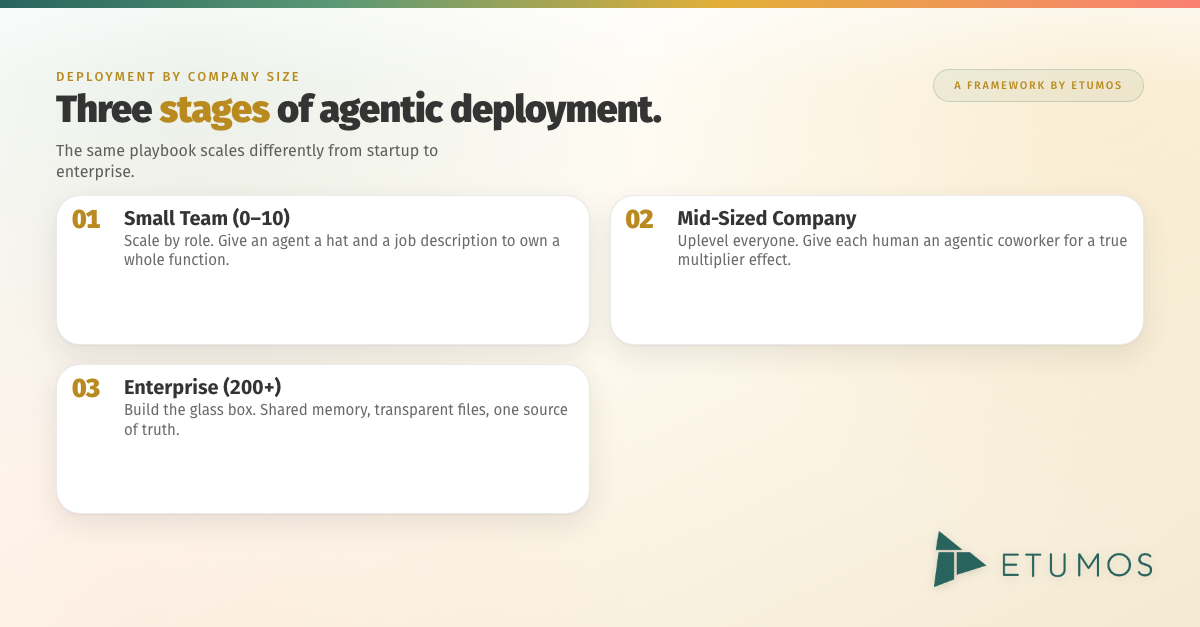
The Small Team (0 to 10 Employees): Scale by Role
If you are a small company, agents are your path to near-infinite scaling. At this stage, do not just use AI to write emails. Use it to own entire functions. You can “hire” a recruiter agent to run your hiring pipeline, or a research agent to handle market intelligence.
By giving an agent a specific hat and a job description, you future-proof the company. You are not a 10-person team anymore. You are a 10-human team supported by a 50-agent workforce, competing with much larger organizations because you hold a specialized execution layer that never inflates your overhead.
The Mid-Sized Company: The Productivity Multiplier
For mid-sized organizations, the goal is upleveling, not replacement. You give every employee an agentic coworker, and that creates a multiplier effect. A marketing manager who could previously run two webinar programs a month can suddenly run 50, because redundant agents handle the staging, QA, and follow-up. The strategy: find the bottleneck tasks inside each role, deploy agents to absorb the high-volume execution, and free your humans for the “primary source” intelligence (the strategy and creativity AI cannot replicate).
The Enterprise (200+ Employees): Build the Glass Box
At enterprise scale, deployment becomes a question of governance and harm reduction. A large organization cannot afford black-box AI where no one can explain why a decision was made. You have to build a glass box, and that takes three components:
- Shared long-term memory: every agent action and dataset lives in a centralized warehouse (Snowflake, BigQuery) so it stays auditable and persistent.
- Shared short-term memory: a transparent file and folder structure where humans can see exactly what the agents are working on right now.
- A centralized source of truth: every agent task originates and is tracked in your project management tool (Jira, Asana). If a task is not in the PM tool, it does not exist for the agent.
How the Multiplier Effect Works
Technically, agentic deployment abstracts the “how” of a task away from the human and hands it to an orchestration layer. In a 2026 marketing ops stack, that usually means a webhook-driven architecture where your CRM or project management tool triggers an agent. The loop looks like this:
- Trigger: a human strategist creates a task in the PM tool, for example “build a new webinar program for the security persona.”
- Orchestration: an agent acting as project manager receives the task and splits it into sub-tasks: research persona interests, clone the Marketo program, update tokens.
- Execution: specialized agents (using the Model Context Protocol) run the sub-tasks, hitting your MAP and CRM through the API.
- Validation: a QA agent reviews the work against a checklist and reports back to the human for final approval.
That is how you get the 1,000x output that founders keep talking about. You are not automating a single email. You are automating the entire decision-and-execution loop, then keeping a human at the gate. This is the backbone of agentic marketing operations, and it extends naturally into agentic revenue operations once the loop proves out.
Pursue Excellence, Not Slop
The biggest risk of an agentic workforce in 2026 is the temptation to scale slop: low-quality, generic output that floods the market and delivers no value. Operational maturity means holding the excellence bar high as your scale climbs. The true ROI of AI is not only saving time. It is doing things that were previously impossible. Signal farming, for instance (proactively monitoring thousands of data points across the web and triggering real-time, personalized responses) is only possible with an agentic workforce. Use your best human brains as the primary source of strategy and agents as the multiplier on execution, and you build experiences competitors cannot buy off the shelf. That balance is the heart of mature agentic operations.
Building Your Agentic Roadmap
Becoming an agentic company is a deliberate move from “using AI” to “integrating agents.” Whatever your size, the goal is the same: maximize output per human hour without sacrificing quality.
- Audit your hats: pick one role that is currently a bottleneck and write a job description for an agent to take over its repetitive components.
- Stabilize your infrastructure: make your project management tool the absolute source of truth. If your humans do not use it correctly, your agents will fail.
- Build the glass box: stand up a centralized data warehouse and a shared file structure so you can audit agent actions in real time.
- Focus on innovation: challenge your team to name one campaign or service that was impossible before AI, then task an agent with building the prototype.
Frequently Asked Questions
What is agentic deployment?
Agentic deployment is the practice of giving autonomous AI agents specific roles, responsibilities, and job descriptions inside your organization, then wiring them into an orchestration layer so they execute real work. Unlike rigid automation, agents reason through tasks, use tools, and adjust to context, which lets a small human team run the output of a much larger one.
How does agentic deployment change with company size?
Small teams (0 to 10) scale by role, giving a single agent an entire function to own. Mid-sized companies give every employee an agentic coworker to create a multiplier effect. Enterprises (200+) focus on governance, building a glass-box infrastructure with shared memory and a centralized source of truth so every agent action is auditable.
What is the difference between an agentic workforce and traditional automation?
Traditional automation follows a fixed “if this, then that” script and breaks the moment conditions change. An agentic worker reasons through a goal, decides which tools to use, and adapts as the context shifts. The calculator gives an answer only with exact inputs; the agent figures out the inputs, structures the work, and flags what it cannot resolve.
How do I avoid scaling “AI slop”?
Keep humans as the primary source of strategy and use agents only as the multiplier on execution. Hold the excellence bar constant as you scale, add a QA agent and a human approval gate to every workflow, and aim agents at things that were impossible before AI (like signal farming) rather than at mass-producing generic output.
Put a Human at the Center
The companies that win will harness the multiplier effect of AI while keeping human strategy at the center. Start small: pick the one role with the highest ratio of manual execution to strategic thinking, and imagine what changes when an agentic coworker takes the repetitive half. If you want help mapping that roadmap to your size and stack, let’s talk.