Corporate AI mandates have a way of landing on the marketing operations team like a fire alarm. The C-suite hands down the directive: we need to use AI, and we needed it yesterday. For most MOps practitioners, that mandate feels less like a breakthrough and more like a threat to brand integrity and data security. You are staring at a false choice: rush into automation that produces low-quality spam, or fall behind in a technical arms race that shows no sign of slowing down. There is a third path, and it starts with treating the mandate as a process problem, not a tooling problem.
The good news is that the teams who win the AI race in 2026 are not the ones with the most licenses. They are the ones who turn proprietary human insight into market-ready output without leaking data or shipping noise. This is a survival guide for doing exactly that.
What Corporate AI Mandates Actually Demand
Meaningful AI adoption is not measured by how many generative tool seats you bought. It is the strategic integration of machine learning and large language models into your existing workflows to raise output quality without compromising security. Think of it like upgrading a factory line. You would not throw a robot into the middle of a manual assembly line and hope for the best. You would re-evaluate the power supply, the safety protocols, and the role of the person overseeing the machine.
For marketing operations, that means shifting from a “tool-first” mindset to a “process-first” mindset. If you use AI to generate 500 mediocre LinkedIn posts, you have not adopted AI. You have automated noise. Real adoption happens when the technology becomes a force multiplier for your most experienced subject matter experts. One conversation with a lead engineer becomes a white paper, a series of blog posts, and a month of social content, all while preserving the nuance and technical accuracy that B2B audiences demand.
A Four-Step Framework for Responding to Corporate AI Mandates
When the directive arrives, resist the urge to pick a tool first. Work the problem in order: secure the data, integrate with what you own, keep humans in the loop, and make every output accountable. Here is how each step works in practice.
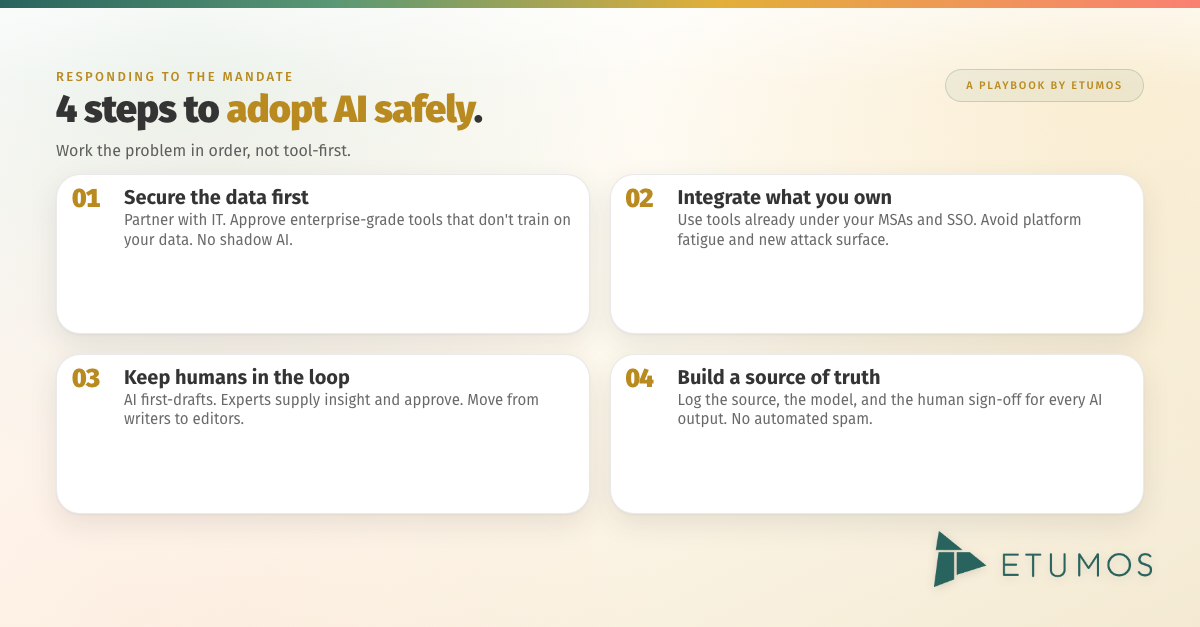
Step 1: Solve the Security and Data Privacy Puzzle First
Before a single prompt is written, MOps must partner with IT and Security. This is the most common unforced error in AI adoption. When teams reach for “shadow AI,” unapproved tools accessed through personal accounts, they risk leaking intellectual property or, worse, customer data into public training models.
Do not ask for blanket permission to “use AI.” Come to the table with a specific use case and a clear understanding of data residency, and identify which tools are corporate-ready. That usually means the vendor offers an enterprise-grade agreement where your data is never used to train their global models. A few guardrails make this concrete:
- Never input personally identifiable information (PII) or your full CRM into a generative tool unless it is an isolated, enterprise-sanctioned instance.
- Check native AI features first. If you run Marketo or HubSpot, those vendors have already done much of the legal heavy lifting on data privacy, which makes them a fast path to compliant implementation.
- Document data residency per tool so Security can sign off once, not every time.
Step 2: Integrate AI Into the Ecosystems You Already Own
One of the biggest friction points in any rollout is platform fatigue. Your team already jumps between Salesforce, Slack, and your project management software. Bolting on three more AI-specific browser tabs is a recipe for low adoption.
Look at what you already pay for. Staying inside established ecosystems, such as Google Gemini for Workspace users or Microsoft Copilot for 365 environments, gives you an immediate security advantage because those tools already fall under your Master Service Agreements and Single Sign-On. For the heavier lifting, a webhook-based integration keeps data movement clean and auditable:
- Trigger: a new case-study interview recording lands in a specific folder.
- Action: the audio is routed to a transcription service, then the transcript is sent to a private LLM instance with a “brand voice” prompt.
- Result: a draft blog post is pushed into your CMS as a “pending review” item, with no copy-paste in between.
Step 3: Implement a Human-in-the-Loop Framework
The loudest fear about AI is that it replaces the human element. In high-stakes B2B marketing, that replacement is a death sentence for brand trust. The fix is a human-in-the-loop (HITL) process: AI handles first-drafting and reformatting, but humans stay the sole source of original insight and the final gatekeepers of quality. The SME-to-artifact workflow looks like this:
- Capture: record a 15-minute technical briefing from a subject matter expert, such as a product manager or lead consultant.
- Transcribe and distill: use AI to transcribe the briefing and pull the five meatiest points.
- Transform: direct the AI to expand those points into a long-form article that follows your brand guidelines.
- Edit: a human reviews the output for technical accuracy and tone before anything ships.
The soul of the content comes from a human expert. The AI does the grunt work of turning notes into full sentences. Your team moves from “writers” to “editors and strategists,” which is the more defensible role anyway.
Step 4: Establish a Source of Truth for Accountability
As AI-generated volume climbs, so does the risk of losing track of what is being published. AI tasks cannot happen in a vacuum. When an automated process fails, or starts producing hallucinated information, you need to know exactly where the breakdown happened. Wire your AI workflows directly into your project management system (Asana, Jira, or Monday.com), and give every AI-generated asset a parent task that records:
- The original source of the data, meaning the human expert.
- The specific AI model and version used.
- The human team member responsible for final sign-off.
That paper trail is what separates a governed program from automated spam. It proves every piece of content was vetted, so your AI adoption protects the company’s reputation instead of damaging it.
Why This Shift Matters in 2026
We are in an AI race where the cost of standing still now outweighs the cost of a measured, secure rollout. The competitive advantage does not belong to the company with the most bots. It belongs to the company that most efficiently turns proprietary human insight into market-ready content. Marketing operations is the bridge between the black box of AI and the messy reality of business growth, which makes MOps the right team to own governance, not just execution. As these tools take on more complex analysis and predictive modeling, the practitioner’s job shifts from managing a database to managing an automated intelligence engine. That is the work Etumos builds with clients across agentic marketing operations and broader agentic operations.
Frequently Asked Questions
How should marketing ops respond to a corporate AI mandate?
Treat it as a process problem, not a tooling problem. Work in order: secure the data with IT and Security, integrate AI into ecosystems you already own, keep a human in the loop for quality, and log every AI output for accountability. That sequence turns a rushed directive into a governed program.
What does responsible AI adoption look like in B2B marketing?
It is the strategic integration of LLMs into existing workflows to raise output quality without compromising security. The goal is using AI as a force multiplier for your subject matter experts, so one expert conversation becomes multiple high-quality assets, rather than generating large volumes of mediocre content.
How do we keep AI from leaking sensitive data?
Never input PII or your full CRM into a generative tool unless it is an enterprise-sanctioned, isolated instance. Favor vendors that offer enterprise-grade agreements where your data is not used to train global models, and check native AI features in tools like Marketo or HubSpot first, since they already handle much of the privacy compliance.
What is a human-in-the-loop workflow for content?
AI handles first-drafting and reformatting while humans supply original insight and final approval. A typical flow captures a short expert briefing, uses AI to transcribe and distill the key points, transforms them into a draft on brand, and routes the draft to a human editor before anything publishes.
Turn the Mandate Into an Edge
The transition to AI-driven marketing operations does not happen overnight, but you can lay the foundation today. Audit your current stack for vendors whose native AI already meets your security bar. Create an “AI safe zone” by approving one or two LLMs with clear data rules. Pilot an SME-first workflow on a single technical topic. Then build an accountability log into your project templates. Done in that order, a corporate mandate becomes a legitimate competitive edge instead of a compliance headache. If you want a partner to design that rollout, from governance to a roadmap for agentic revenue operations, let’s talk.