You know the feeling of a high-priority campaign sitting in the “QA queue” for three business days because the team is stretched thin. You’ve felt the stomach-drop of spotting a broken link or a typo in a token-heavy email minutes after sending to 50,000 leads. In marketing operations, we treat quality assurance as a necessary friction that keeps us from moving as fast as the business demands. AI feedback loops remove that friction, not by skipping steps, but by embedding them into the process itself.
The tension is real: we want to scale campaign volume infinitely, but human bandwidth creates a hard ceiling. Every new campaign adds a linear amount of manual checking and cross-referencing. AI feedback loops break that linear relationship.
What Are AI Feedback Loops in Marketing Ops?
An AI feedback loop is an automated system where an AI agent monitors the output of a task, evaluates it against predefined standards, and feeds improvements back into the production cycle without waiting for a human to start the process. In campaign operations, it means moving from a world where a person checks a ticket to one where the project management system itself watches the work as it’s staged.
Think of a modern spell-checker versus an editor. Traditional QA is like sending a finished manuscript to an editor: you wait days, then make changes. An AI feedback loop is the real-time grammar suggestion in your browser. It happens as you work, shifting feedback left to an earlier stage in the lifecycle. By the time a human looks at a campaign brief or a staged email, the “silly” mistakes have already been caught and corrected by an agentic layer.
How Agentic QA Transforms Campaign Operations
An “agentic layer” is AI that takes action across your tech stack: interacting with your project management tools, your email testing suites, and your marketing automation platform (MAP). Instead of just generating text, these agents perform tasks against a standard lifecycle.
Automated QA checklists
You can design agents to run a comprehensive QA checklist the moment a campaign moves to a specific stage on your Kanban or sprint board. Once a Marketo email is staged, an agent can send that HTML into Litmus or Email on Acid, retrieve the rendering results, and attach them to the Jira or Asana ticket. If it detects a broken link, a missing UTM parameter, or a rendering issue in Outlook, it flags the ticket and moves it back to “In Progress” with specific instructions.
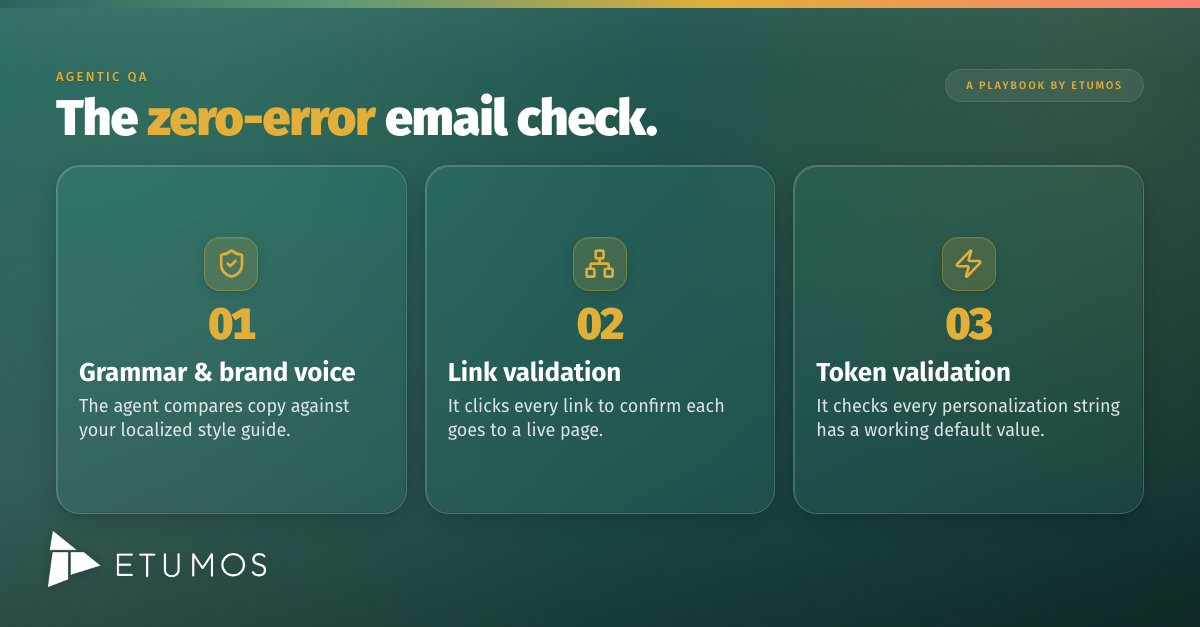
The “zero-error” email flow
A marketing manager submits a campaign brief. The agent stages the emails in HubSpot, and a feedback loop runs a series of checks in parallel:
- Grammar and brand voice: the agent compares the copy against your localized style guide.
- Link validation: it “clicks” every link to confirm each goes to a live page.
- Token validation: it checks that every personalization string has a working default value.
The operating expense for these checks approaches zero. You aren’t paying a specialist to click links; you’re paying once for the design of the agentic workflow.
The Technical Architecture: Closing the Loop
To implement this, your project management system needs a standard campaign lifecycle: not just a “to do” list, but a structured data model where each movement between lanes triggers a specific API call. When a campaign moves from “Drafting” to “Staging” in a tool like Jira, it fires a webhook to an orchestration layer (Workato or n8n). That layer calls an evaluator agent, which browses the staged email in your MAP, runs its checklist, and posts a comment through the project management API: “QA check complete. 3 errors found: 1 broken link on CTA, 2 missing alt-text tags.” The ticket status updates automatically. The AI is both the worker and the auditor, which is what makes it a closed loop.
Why Automated QA Matters
The volume of personalized content required to stay competitive is skyrocketing. If you still rely on a linear, human-led QA process, you become the bottleneck that prevents your company from scaling. High-maturity teams drive the marginal cost of a new campaign toward zero. Operational maturity is increasingly defined by how many closed loops you have running. Automating the quality flow frees your MOps professionals to focus on strategy, data architecture, and high-level problem solving instead of the “night job” of manual proofreading.
Frequently Asked Questions
What is an AI feedback loop in marketing operations?
It’s an automated system where an AI agent monitors a task’s output, evaluates it against predefined standards, and feeds corrections back into the production cycle without human initiation. In practice, the project management system watches and checks campaign work as it is staged.
How does agentic QA differ from manual QA?
Manual QA is linear: a person checks each campaign, adding time with every launch. Agentic QA shifts checks left and runs them automatically when a campaign moves stages, so silly errors are caught before a human ever reviews the work, and the marginal cost approaches zero.
What can an evaluator agent actually check?
Common checks include grammar and brand voice against your style guide, link validation to confirm live pages, token and default-value validation, UTM parameters, and email rendering across clients via tools like Litmus or Email on Acid.
What do I need to build a closed-loop QA system?
A standardized campaign lifecycle in your project management tool, a codified QA checklist, your testing tools connected via API, and an orchestration layer (such as Workato or n8n) to trigger an evaluator agent on stage changes.
Build Your First Closed Loop
Automated QA moves MOps from “button-pushers” to “system architects,” where QA isn’t a step you do but a state the system maintains. Start small: standardize your lifecycle, codify your checklist, connect your testing tools, and set up one evaluator agent to catch broken links and missing UTMs. Etumos builds these agentic workflows on your existing stack, from agentic marketing operations to governed agentic operations. To design your zero-error campaign flow, let’s talk.