You have spent years perfecting your Marketo or Salesforce instance: the lead routing, the scoring models, the nurture logic that took quarters to get right. Now the pressure to deploy AI agents is mounting, and the old stack feels like a liability. Here is the good news: modernizing your marketing technology stack does not mean a rip-and-replace migration to some “AI-first” platform that may not be ready for another year. It means a phased upgrade of the system you already own, done in an order that returns value at every step.
The tension most teams feel is a false binary: tear everything out and rebuild, or sit on your hands waiting for vendors to ship native AI features. There is a third path, and it is the one practitioners actually take: turn the platform you already own into a capable host for agentic workflows, one use case at a time.
Why Modernize Instead of Replace
Think of your stack like a house with good bones. The foundation is solid, the plumbing works, and you know where every pipe runs. You would not demolish it to add smart-home wiring; you would run new conduit through the walls that already exist. Modernizing your marketing technology stack works the same way: your Marketing Automation Platform (MAP) and CRM stay in place as the system of record, and you thread modern intelligence through the plumbing you already trust. A full migration compounds risk (relearning a platform, re-mapping every field, re-validating every integration, absorbing months where nothing ships). A phased modernization carries almost none of that, because each phase is small, reversible, and live in days rather than quarters.
Step 1: Assess What Your Stack Already Does
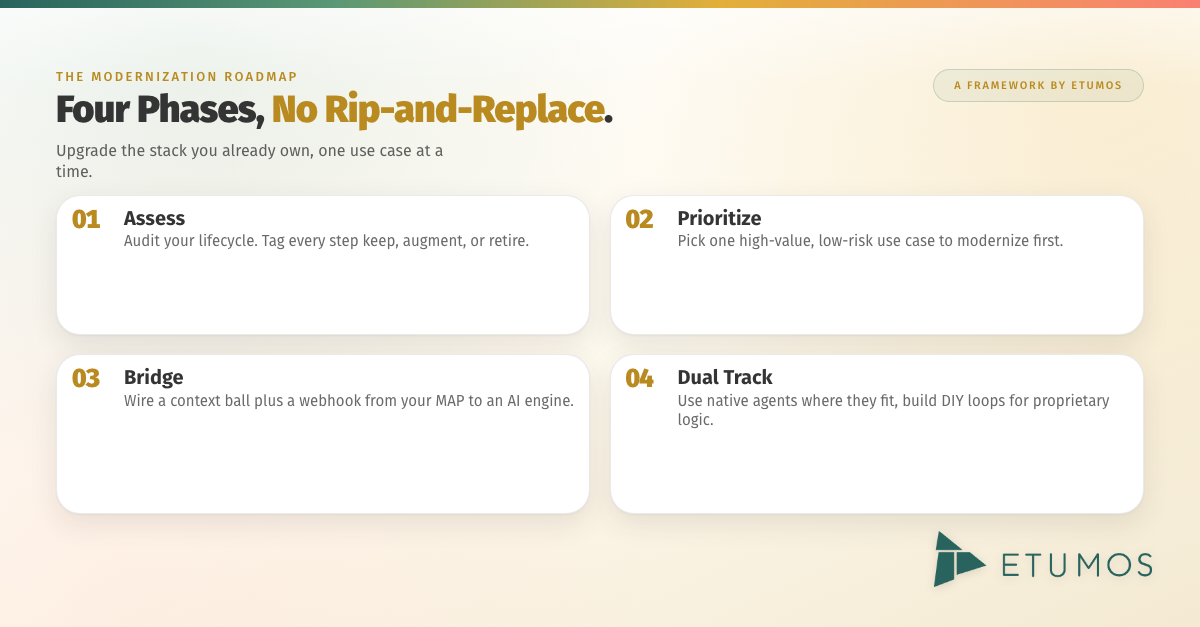
Before you add anything, audit what you have. Modernization starts with an honest inventory, not a shopping list. Walk your campaign lifecycle end to end and tag every step in one of three buckets:
- Keep as-is: reliable, deterministic logic that works. Field updates, channel sends, compliance rules. These do not need AI; leave them alone.
- Augment: steps where a human currently makes a judgment call that an agent could draft. Lead qualification, content recommendation, message personalization. These are your modernization targets.
- Retire: brittle workarounds and zombie programs nobody trusts. Note them, but do not let cleanup block the upgrade.
The output is a short list of “augment” candidates ranked by how much manual judgment they consume today. That ranked list is your roadmap. Most teams find three to five high-value moments hiding in plain sight, usually wherever a person reads a record and decides what happens next.
Step 2: Prioritize One High-Value Use Case
Do not modernize everything at once. Pick a single use case from your “augment” list where the payoff is obvious and the blast radius is small. Product-interest profiling is a common first choice: instead of a generic nurture email, an agent reads a lead’s recent activity and writes a one-sentence summary of what they are actually shopping for.
The discipline here is restraint. A modernization that tries to AI-enable the whole funnel on day one collapses under its own complexity. One reliable agentic loop earns trust, generates a result you can measure, and gives you a template to repeat. Choose the use case where a small win is visible to the people who fund your roadmap.
Step 3: Build the Bridge With a Context Ball and a Webhook
To deploy an agent inside an older stack, you have to bridge hard-coded logic and a probabilistic language model. Two components do that work: the “context ball” and the webhook.
A webhook is a real-time data push from one system to another. It is the telephone line that lets Marketo call an AI engine and ask for a decision. But a model cannot make a smart decision from an email address alone. It needs the full story.
That is the context ball: a single data briefcase that travels with a person record. Rather than sending fragmented fields, you run a background program that compiles all the relevant demographics, firmographics, and recent behavior into one structured JSON field. The ball packs everything you would hand a salesperson before a call (account summary, company insights, behavioral triggers) so the agent acts with full situational awareness instead of guessing.
How the Loop Works in Practice
Inside Marketo, a background smart campaign keeps the context JSON field current, firing whenever something meaningful changes (a new job title, a high-intent page view). When the trigger condition is met, a smart campaign sends a webhook carrying the context ball and a specific instruction to a middleware layer or directly to an LLM endpoint. The payload is simple:
- The input: the full context ball, plus a plain-language instruction like “based on this lead’s recent activity in our security category, suggest the next best resource from our 2026 library.”
- The model: the LLM reads the context and returns a structured response, not just what the lead did but what they likely need next.
- The output: middleware maps that response back into a Marketo field, for example AI_Next_Best_Offer, where your existing programs can see it.
Once the answer lands back in your MAP, a “traffic director” program takes over. If the agent flags high interest in a specific use case, your existing routing logic instantly enrolls the lead in the right nurture stream or alerts the right rep. The new intelligence rides on rails you already built.
Step 4: Run a Dual Track of Native and DIY
While you build your own agentic layers, your vendors are racing to ship native ones. Salesforce Agentforce, for instance, lets systems coordinate by “programming with words” rather than rigid logic. These native features are strong for broad, standardized tasks, but they rarely capture the hyper-specific logic your business runs on.
The durable strategy is dual track: use native feature agents where they fit out of the box, and build your own webhook loops for proprietary logic that no vendor will ever ship for you. That hybrid keeps you from betting the stack on a single roadmap, and it future-proofs the upgrade. You adopt native intelligence as it matures without ever waiting on it to start.
Why This Matters in 2026
Operational maturity in 2026 is not measured by who bought the newest platform. It is measured by how legible your existing data is to AI. The teams pulling ahead made their person records readable to an agent and wired that intelligence into the workflows they already run. Build context balls and webhook bridges and you are effectively creating an API for your go-to-market strategy: you move from rigid rules to fluid, intelligent responses, and you scale experiences like next-best-content at a volume manual work could never reach. You stop maintaining a database and start directing a system that adapts in real time, and you got there without the cost, risk, and downtime of a full migration.
Frequently Asked Questions
What does modernizing your marketing technology stack actually involve?
It means phasing AI and agentic capability into the MAP and CRM you already own, rather than migrating to a new platform. You assess your current workflows, prioritize one high-value use case, and bridge your system to an AI engine with a webhook and a structured context field. Each phase is small, reversible, and live in days, so you modernize without the downtime of a rip-and-replace.
Do I have to replace Marketo or Salesforce to deploy AI agents?
No. Your existing MAP and CRM stay in place as the system of record. You add a webhook bridge that lets them call an AI engine for a decision, then write that decision back into a field your current programs already read. The reliable plumbing you built keeps working; you are layering intelligence on top of it, not tearing it out.
What is a context ball and why does the agent need one?
A context ball is a single structured JSON field that travels with a person record and holds everything an agent needs to act: demographics, firmographics, account summary, and recent behavior. Without it, the model only sees fragments and guesses. With it, the agent has the same full briefing you would hand a salesperson, so its output is grounded in your real data instead of generic assumptions.
Where should I start modernizing first?
Start by auditing your campaign lifecycle and tagging each step as keep, augment, or retire. From the “augment” list, pick one high-value, low-risk use case (product-interest profiling is a common first win) and build a single webhook loop for it. Ship that, measure the result, then repeat the pattern on the next use case. One reliable loop beats a funnel-wide overhaul that never lands.
Your Modernization Roadmap
Modernizing your marketing technology stack is a project of clever engineering, not big spending. Audit your lifecycle to find the manual judgment calls, build a context ball for one record type, configure a single webhook to an LLM, and map the response to a traffic director that takes real action. Then do it again. Etumos helps teams run this exact upgrade, from agentic marketing operations to agentic operations across the funnel and a roadmap for agentic revenue operations. If you want to modernize the stack you already own instead of starting over, let’s talk.